
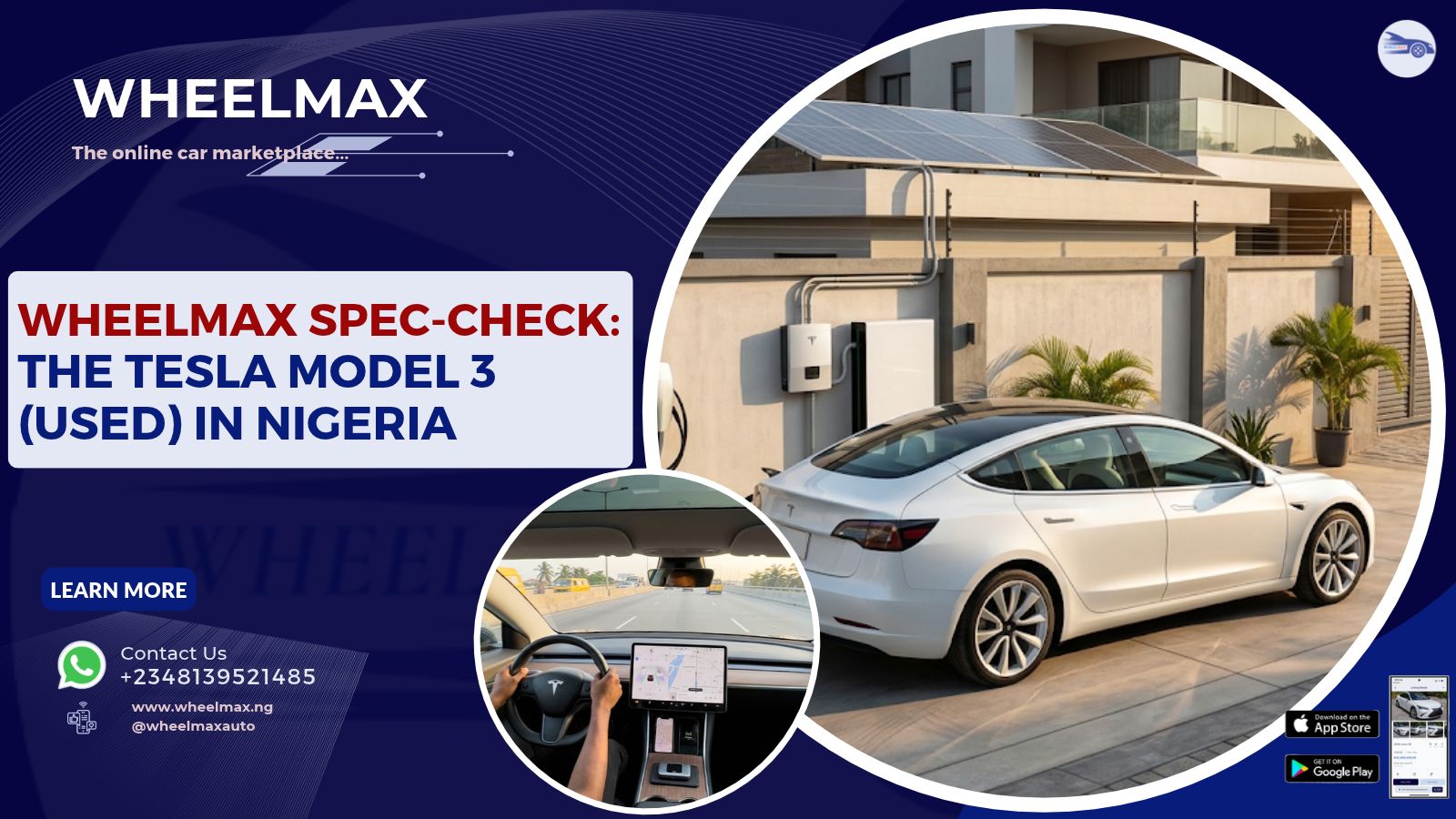
A few years ago, seeing an electric vehicle glide silently down the Lekki-Ikoyi Link Bridge in Lagos or cruise along Shehu Shagari Way in Abuja felt like an anomaly. The immediate reaction from most motorists was skepticism: "How can an electric car survive in a country with unstable grid power and rough roads?"
Fast-forward to today, and the conversation has changed.
Driven by rising fuel prices and growing interest in renewable energy, the Tesla Model 3—particularly pre-owned 2019 to 2023 models imported from the United States—has carved out a genuine foothold among forward-thinking luxury car buyers. The appeal is straightforward: instant acceleration, a futuristic cabin, zero engine maintenance, and the ability to bypass petrol filling stations entirely.
However, owning an electric vehicle in Nigeria is fundamentally different from driving a conventional petrol car. There is no official Tesla service center in West Africa, no nationwide public Supercharger network, and local roads present physical and environmental challenges that foreign automakers never factored into their factory designs.
In this edition of Wheelmax Spec-Check, we deliver an honest, engineering-focused evaluation of owning a used Tesla Model 3 in Nigeria: dissecting real-world battery range, home charging solutions, software connectivity, pothole survival, and long-term ownership economics.
1. Model Variants: Choosing the Right Trim for Nigeria
When shopping the Nigerian pre-owned market, you will primarily encounter three configurations of the first-generation Model 3:
Which Trim Makes Sense for Nigerian Roads?
1. The Best All-Rounder: Long Range AWD. The Long Range model features a 75-to-82 kWh battery pack. That larger capacity provides a vital safety buffer against power outages, unexpected traffic gridlock, and the heavy energy draw of continuous air conditioning in tropical heat.
2. The City Commuter: Standard Range Plus (RWD). Featuring a smaller battery (50 to 60 kWh), this trim is adequate for daily urban commuting within Lagos or Abuja, but requires more frequent charging cycles.
3. The Trim to Avoid: Performance Model. While its 3.1-second acceleration is impressive, the factory suspension is lowered by 10 mm and paired with large 20-inch alloy wheels wrapped in ultra-low-profile tires. Over Nigerian potholes and bridge expansion joints, these wheels are prone to bending, and the lowered chassis regularly scrapes on standard speed bumps.
2. Real-World Range: The Tropical Climate Reality
Factory EPA range estimates assume mild ambient temperatures and steady cruising on smooth highways. In Nigeria, environmental conditions alter your battery consumption:
1. The 35°C Air Conditioning Load: Cabin climate control is non-negotiable in Nigeria. Cooling a glass-roofed cabin during a hot afternoon draws between 1.5 kW and 3.0 kW of electrical power directly from the high-voltage battery pack. This continuous climate draw reduces your total driving range by roughly 15% to 20% compared to factory estimates.
2. The Traffic Idling Advantage: Unlike petrol engines that waste expensive fuel while idling in bottleneck traffic, the Model 3’s electric motors consume zero energy when stationary. Only the air conditioning, sound system, and computers draw power. In a two-hour gridlock on the Third Mainland Bridge, the vehicle typically consumes only 4% to 6% of its battery capacity keeping the cabin cool.
3. Sentry Mode Phantom Drain: Tesla's "Sentry Mode" uses external cameras to record activity around the car when parked. While valuable for security, running four cameras and the onboard computer continuously drains roughly 5% to 8% of the battery pack every 24 hours. If you leave the car parked at an airport or office lot for several days with Sentry Mode active, factor this drain into your charging plans.
3. The Charging Playbook: Living Without Superchargers
The lack of a public Tesla Supercharger network in Nigeria is not an obstacle if you understand that EV ownership is centered around home and workplace charging.
Three Practical Ways to Charge in Nigeria:
1. Solar & Lithium Inverter Synergy (The Gold Standard): Pairing the car with a domestic solar system is the most cost-effective ownership model. A 10kVA to 15kVA solar inverter setup backed by 15 kWh to 30 kWh of lithium (LiFePO4) storage allows you to charge the vehicle during peak daylight hours for practically zero marginal cost.
2. Overnight Domestic Grid Power: Using the portable Tesla Mobile Connector plugged into a standard, properly grounded 220V socket (drawing 10 to 13 Amps), the car recovers 15 to 20 km of range per hour. Plugging it in overnight for 10 hours while you sleep adds 150 to 200 km—more than enough for two to three days of average city driving.
3. Generator Charging During Outages: An 8kVA or larger domestic generator can charge the vehicle via the Mobile Connector. To prevent overloading the generator's alternator, manually reduce the charging current on the Tesla touchscreen to 12A or 16A.
Critical Rule: The generator and socket must have a verified physical earth/ground rod connection. If the car detects a missing electrical ground, it will halt charging and display a "Charging Source Ground Missing" error on screen.
4. Ground Clearance & Suspension Realities
The Tesla Model 3 was engineered for well-paved foreign roads. Operating one on Nigerian infrastructure requires specific mechanical precautions.
The Low Ground Clearance Risk
The factory Model 3 has a ground clearance of approximately 140 mm (5.5 inches).
The High-Voltage Battery Hazard: The lithium-ion battery pack is integrated into the bottom floorpan of the car. While shielded by factory aluminum and composite undertrays, a violent impact with an exposed rock, jagged concrete gutter edge, or oversized municipal speed bump can puncture cooling channels or dent the battery enclosure, creating a repair bill that can exceed N10 million.
The Practical Upgrade: Many Nigerian Tesla owners install an aftermarket 1.0-inch to 1.5-inch suspension lift spacer kit and replace the factory composite undertrays with heavy-duty 5 mm aluminum skid plates. This modification raises ground clearance to roughly 165 mm to 175 mm, allowing the car to clear steep ramps, speed bumps, and shallow water puddles safely.
Suspension Wear Points
Because the Model 3 carries a heavy battery pack, its curb weight is high (1,700 to 1,850 kg). Over rough roads, the front upper control arm ball joints can develop squeaks and play around 60,000 to 80,000 km. Upgrading to heavy-duty aftermarket control arms with serviceable, greasable ball joints resolves this permanently.
5. Software, Autopilot & Connectivity in Nigeria
Teslas rely heavily on software and onboard computing. Here is how these systems operate locally:
Cellular Connectivity & Navigation
US-spec vehicles come with an embedded American eSIM that cannot connect to Nigerian cellular networks (MTN, Airtel, Glo).
The Workaround: The vehicle connects easily to external Wi-Fi. Keeping a dedicated 4G/5G mobile hotspot (MiFi) inside the center console or connecting to your smartphone’s personal hotspot allows the car to load satellite navigation maps, play streaming media, and download over-the-air firmware updates.
What Autopilot Can (and Cannot) Do on Local Roads
What Works Well: Traffic-Aware Cruise Control (TACC) functions reliably. On paved expressways like the Lekki-Epe Expressway, Airport Road in Abuja, or the Lagos-Ibadan corridor, the forward radar and cameras track preceding vehicles, maintaining safe following distances and braking smoothly.
What Struggles: Autosteer (Lane Keep Assist) relies on clear, painted lane markings. On unpainted, faded, or eroded tarmac, Autosteer will frequently alert the driver and disengage. Autopilot should be used as a convenient highway driving aid, not as an autonomous driver on inner-city streets.
6. Maintenance Profile: What Actually Breaks?
The primary financial benefit of an EV is the complete elimination of internal combustion engine maintenance.
Components You Never Have to Service or Replace:
- No engine oil or oil filters
- No spark plugs or ignition coils
- No timing belts, chains, or tensioners
- No alternators, starter motors, or drive belts
- No fuel pumps, fuel injectors, or fuel filters
- No exhaust repairs, oxygen sensors, or catalytic converter thefts
Wear Items You Must Still Maintain:
Tires: Because electric motors deliver instant torque from zero RPM and the vehicle is heavy, tires wear faster than on a standard saloon. Plan to replace tires every 35,000 to 45,000 km. Choose standard 18-inch wheels over 20-inch rims for better pothole protection.
Braking System: Thanks to Regenerative Braking - where the electric motors slow the car down while recapturing energy - the mechanical brake pads and discs are rarely used under normal driving. Pads frequently last over 100,000 km. However, brake fluid should still be tested for moisture content every two years.
Cabin Air Filters: Replace annually to prevent dust and musty odors from entering the cabin.
12V/16V Auxiliary Battery: Powers the car's computer systems, displays, and door locks. When this small battery reaches the end of its life (typically every 3 to 4 years), it must be replaced promptly to prevent the car from locking up.
Pre-Purchase Inspection Checklist for Nigerian Buyers
Before purchasing a foreign-used (tokunbo) Tesla Model 3, complete these non-negotiable checks:
1. Verify Title History (Avoid Flood Salvage): Many imported used EVs originate from US insurance auctions. Pull the 17-digit VIN using Carfax or AutoCheck. Avoid any vehicle with a Flood or Water Damage title. Moisture inside high-voltage junction boxes or battery modules causes unpredictable electrical failures that are difficult to trace locally.
2. Inspect the Underbody Battery Casing: Place the vehicle on a lift or ramp and thoroughly inspect the bottom aluminum battery shell. Check for deep gouges, puncture marks, or structural indentations. Any dent deeper than 10 mm in the battery casing is a severe structural warning sign.
3. Check Battery Degradation via Service Mode: Access the onboard Tesla Service Mode menu to review battery capacity. A healthy four- to five-year-old battery pack should retain at least 88% to 92% of its original capacity.
4. Confirm Fast Charging Status: Certain heavily damaged salvage vehicles have their DC fast-charging capabilities disabled remotely by Tesla. Ensure that the vehicle can accept fast DC charging without software restrictions.
The Wheelmax Verdict
A used Tesla Model 3 in Nigeria is not an all-purpose vehicle for every driver.
If you live in an apartment without a dedicated charging spot, depend entirely on public electricity, or regularly travel through unpaved rural terrain, the low ground clearance and charging logistics will be frustrating.
However, for an urban homeowner with an established domestic power setup - particularly a solar inverter system - the Model 3 is an outstanding daily driver. It eliminates fuel queues, eliminates routine engine servicing costs, delivers sports-car acceleration, and provides an exceptionally quiet, modern driving experience.
When fitted with protective aluminum skid plates, sensible 18-inch tires, and charged consistently at home, a pre-owned Tesla Model 3 is one of the most efficient, technologically advanced, and rewarding executive cars you can drive on Nigerian roads.
Considering the switch to an electric vehicle? From computerized high-voltage battery health diagnostics and undercarriage structural audits to charging equipment installation guidance, consult the specialized automotive engineers at Wheelmax today.