
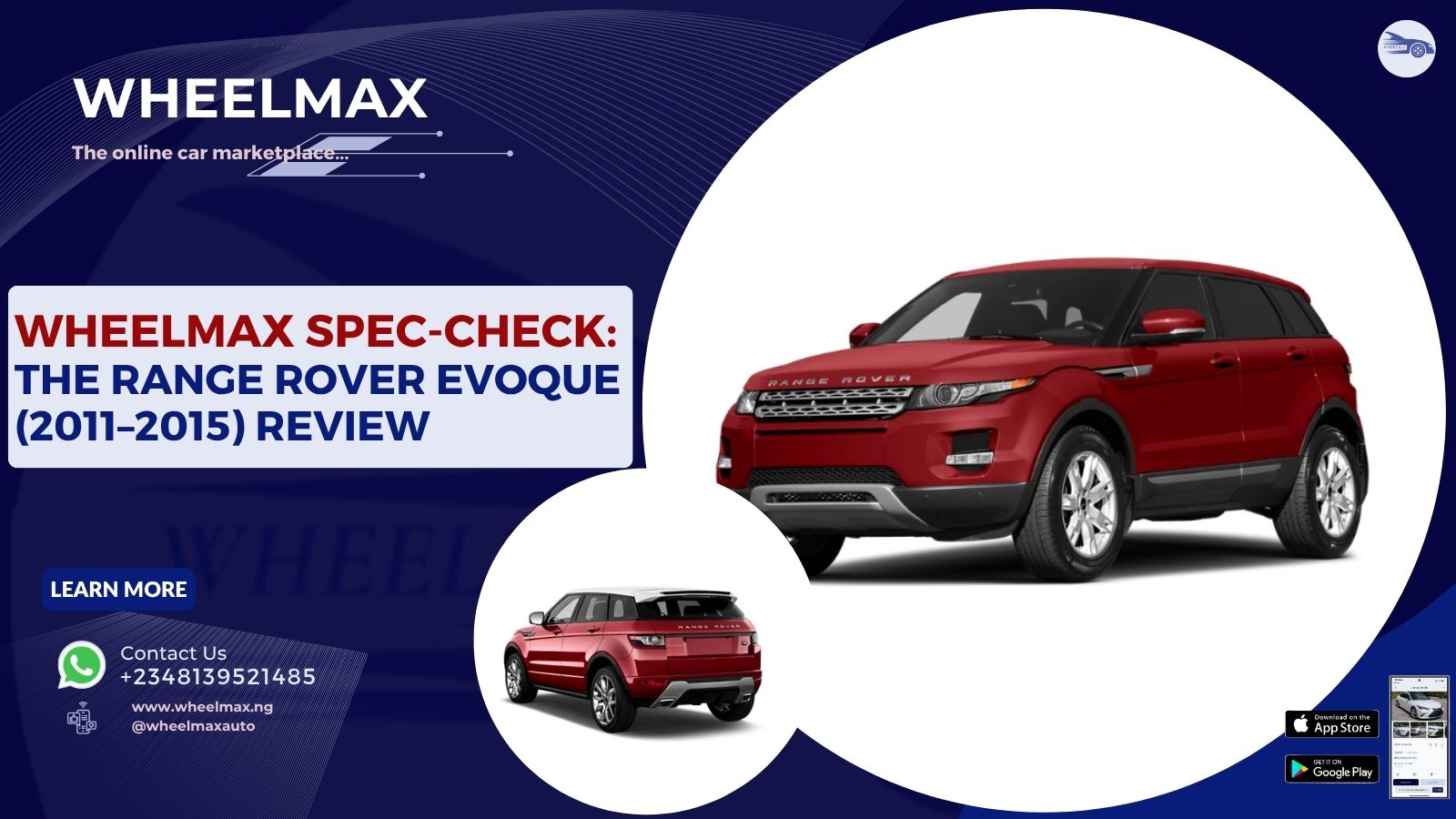
When Land Rover unveiled the Range Rover Evoque in 2011, it shattered the traditional SUV mold. Derived from the radical LRX concept car, the first-generation Evoque (internally designated the L538) proved that a compact crossover could command the same curb appeal as a flagship Vogue.
More than a decade later, the 2011–2015 Evoque remains one of the most striking sights on Nigerian roads. From the streets of Victoria Island and Lekki to the residential boulevards of Maitama, Abuja, it offers a badge of luxury, head-turning design, and Range Rover pedigree at a fraction of the cost of a brand-new vehicle.
However, behind that tapered roofline and prestige badge lies a complex British machine that demands uncompromising care. In a motoring environment characterized by intense tropical heat, unpredictable fuel quality, and jarring road craters, the Evoque can either be a rewarding daily statement or a punishing financial headache.
In this edition of Wheelmax Spec-Check, we provide an honest, engineering-backed review of the 2011–2015 Range Rover Evoque: its iconic design, interior luxury, and the real-world maintenance costs of owning one in Nigeria.
1. Design & Interior: Why the Allure Still Holds
The primary reason anyone buys a first-generation Evoque is obvious: it still looks modern.
While many luxury SUVs from the 2011–2015 era have aged visibly, Gerry McGovern’s rising beltline, aggressive shoulder stance, jewel-like projector headlamps, and distinctive "floating" roof give the Evoque an enduring road presence.
Step inside, and the cabin continues the visual spectacle:
1. The Theater of the Start-Up: Press the start button, and the motorized aluminum rotary gear selector rises smoothly from the center console while the needles sweep across the instrument binnacle.
2. Materials and Craftsmanship: The dashboard and door cards on higher trims (Prestige and Dynamic) are wrapped in genuine double-stitched Oxford leather, accented with genuine aluminum trim rather than silver-painted plastic.
3. Acoustic Excellence: Equipped with the optional 380-watt or 825-watt Meridian Sound System, the Evoque delivers crisp highs and rich bass that rival high-end audio setups in modern luxury sedans.
4. The Panoramic Sunroof: The full-length panoramic glass roof floods the cabin with light, offsetting the cocoon-like feeling created by the high waistline and slim windows.
Ownership Note: The panoramic roof is fixed (it does not open) and relies on a motorized fabric sunblind. In Nigeria’s intense afternoon heat, ensure the sunblind motor and tracks are functional; if the blind is torn or jammed, the glass turns the cabin into a greenhouse, straining your A/C system.
2. Powertrain & Driving Dynamics: Under the Hood
The majority of foreign-used (tokunbo) Evoques imported into Nigeria feature the 2.0-liter turbocharged inline-4 petrol engine (Si4).
The Engine: 2.0L Turbocharged Si4
1. Power Output: 240 horsepower and 250 lb-ft (340 Nm) of torque.
2. Lineage: This engine is mechanically based on the Ford EcoBoost 2.0L architecture (developed during Ford’s ownership of Jaguar Land Rover).
3. The Good News: Because it shares engine DNA with vehicles like the Ford Edge and Explorer, essential mechanical consumables—such as spark plugs, oil filters, and basic sensors—are far easier to source in Nigeria than parts for an exotic V8.
4. The Driving Feel: Acceleration is punchy, with immediate mid-range torque that makes city overtakes on the expressway effortless.
The Transmission Divide: 6-Speed vs. 9-Speed
If you are shopping the pre-owned market, understanding the gearbox transition is critical:
2011–2013 Models (Aisin Warner 6-Speed Automatic):
Uses a conventional 6-speed torque-converter automatic.
Verdict for Nigeria: Highly robust. While it yields slightly higher fuel consumption on the highway, it shifts predictably, tolerates stop-and-go traffic well, and suffers far fewer electronic software glitches.
2014–2015 Models (ZF 9-Speed Automatic):
- Introduced to lower emissions and improve cruising fuel economy.
- Verdict for Nigeria: Noticeably less refined at low speeds. It is prone to gear-hunting between 1st, 2nd, and 3rd gears in dense traffic, often resulting in jerky hesitation unless the Transmission Control Module (TCM) runs the latest factory software updates.
3. The Nigerian Reality Check: 5 Known Failure Points
Owning a luxury European vehicle in Nigeria requires knowing where the weak links are before they strand you. Here are the five mechanical realities of the 2011–2015 Evoque:
Turbocharger & Exhaust Manifold Cracking
1. The Symptom: Sluggish acceleration, a whining "dentist drill" noise under boost, a strong smell of exhaust fumes in the cabin, or a persistent P0299 (Turbocharger Underboost) code on your dashboard.
2. The Cause: The factory exhaust manifold and turbocharger turbine housing are manufactured as an integrated stainless-steel casting. Under heavy thermal load, internal cracks develop along the wastegate port and manifold runners.
3. The Reality: Repairing this requires replacing the turbocharger assembly. Budget between N450,000 and N800,000 for a certified replacement turbo unit, plus labor.
Timing Chain Stretch & Guide Wear
1. The Symptom: A sharp, metallic rattling sound coming from the passenger side of the engine bay during a cold start that lasts 3–5 seconds, accompanied by an engine check light (codes P0016 / P0017).
2. The Cause: Direct-injection engines produce fine carbon soot that contaminates engine oil. If previous owners followed the unrealistic 15,000 km European oil change intervals, the plastic chain guides deteriorate and the timing chain stretches.
3. The Reality: If ignored, the chain will jump teeth, causing the valves to impact the pistons and destroying the cylinder head. Replacing the timing chain, tensioners, and VVT cam sprockets proactively is a major service item.
Magnetic Adaptive Suspension (MagneRide) Blown Struts
1. The Symptom: Excessive bouncing over uneven roads, a rough ride, or hydraulic oil running down the shock absorber bodies.
2. The Cause: Evoques equipped with the Dynamic package feature active electronic dampers containing magnetorheological fluid. While they offer superb handling on smooth pavement, repeated impacts with deep Nigerian potholes blow their internal seals.
3. The Reality: OEM replacement MagneRide struts cost upwards of N400,000 to N600,000 per strut. Consequently, many Nigerian owners convert their suspension to standard passive (non-magnetic) Bilstein or OEM-standard struts to cut long-term maintenance costs.
Brittle Plastic Cooling Pipes & Overheating
1. The Symptom: Sudden loss of coolant, sweet smell after parking, or sudden temperature gauge spikes.
2. The Cause: The 2.0 Si4 engine features complex plastic coolant crossover pipes, water pump elbows, and turbocharger cooling lines located in tight spaces around the engine block. After 8 to 10 years of baking under intense under-hood heat, the plastic degrades and snaps without warning.
3. The Reality: Overheating an aluminum engine block will instantly warp the cylinder head or blow the head gasket. Replacing aging coolant plastic pipes proactively is non-negotiable.
Rotary Shifter & Electrical Gremlins
1. The Symptom: The rotary gear selector stays stuck inside the console and refuses to rise upon turning on the ignition, locking the car in Park.
2. The Cause: Solder joint fractures inside the Gear Shift Module (GSM) or a dying auxiliary battery.
3. The Reality: In most cases, the shift module requires re-soldering or replacement. Furthermore, the Evoque is heavily dependent on stable electrical current; an aging or under-voltage main battery will trigger false warning lights for the ABS, airbag, and Terrain Response systems.
4. Real-World Ownership Costs in Nigeria
To own an Evoque comfortably without financial distress, you must distinguish between basic servicing and long-term maintenance:
Routine Servicing (Every 6,000 – 7,500 km)
1. Oil Specification: 5.4 to 5.6 Liters of high-grade 5W-30 Full Synthetic Oil meeting Ford WSS-M2C913-C or JLR STJLR.03.5003 standards.
2. Filter Consumables: Genuine oil filter, engine air filter, and cabin pollen filter.
3. Estimated Cost: Expect to spend N75,000 to N120,000 per routine service, depending on the brand of synthetic oil used.
Fuel Appetite
The turbocharged Si4 engine is sensitive to fuel octane. Running low-octane, adulterated fuel triggers pre-ignition (engine knock), which causes the ECU to retard timing, significantly reducing power and increasing fuel consumption.
City Driving (Lagos/Abuja Traffic): 13 – 16 Liters / 100 km (roughly 6.5 – 7.5 km per Liter).
Highway Cruising: 8.5 – 10 Liters / 100 km (roughly 10 – 11.5 km per Liter).
Recommendation: Use premium petrol from reputable high-volume stations and use a quality fuel system cleaner every 5,000 km to combat intake valve carbon buildup.
Annual Maintenance Buffer
Beyond routine oil changes, prospective owners should maintain an emergency maintenance reserve of N1,000,000 to N1,500,000 annually to address wear-and-tear items such as suspension bushings, motor mounts, brake pads/rotors, and electronic modules.
5. The Wheelmax Buyer’s Checklist: How to Buy a Good One
If you are determined to bring a 2011–2015 Range Rover Evoque into your garage, do not buy with your heart alone. Follow this pre-purchase inspection checklist:
1. Insist on a Cold Start: Arrive to inspect the car when the engine has been sitting cold for several hours. Listen closely for any timing chain slap or rattling during the first 5 seconds of ignition.
2. Check the Rotary Shifter and Gears: Shift smoothly through P, R, N, and D several times. Ensure the knob rises and lowers without stuttering and that there are no violent clunks when engaging Reverse or Drive.
3. Run a Dedicated JLR Diagnostic Scan: Generic OBD-II code readers only scan basic emissions. Demand a diagnostic scan using dedicated Land Rover software (such as JLR SDD or advanced Autel/Launch tablets) to inspect all 20+ computer modules for hidden network and electrical communication faults.
4. Inspect the Turbocharger Wastegate Arm: Reach behind the heat shield (when cold) and check if the wastegate actuator arm has excessive physical play. Loose linkages signify impending boost failure.
5. Examine the Suspension Dampers: Check if the dampers have electronic wires connected to the top of the strut tower (Adaptive Dynamics) or if the car has already been converted to passive shocks. Verify there are no hydraulic fluid leaks.
The Verdict: Prestige with Prudence
The 2011–2015 Range Rover Evoque remains a design triumph. It delivers genuine luxury, peerless aesthetic appeal, and an elevated driving position that makes you feel special every time you step behind the wheel.
However, it is not a low-maintenance economy crossover, and it cannot be serviced by untrained roadside mechanics. It requires an owner who respects its engineering: one who changes the oil ahead of schedule, uses high-grade synthetic lubricants, addresses coolant leaks immediately, and diagnoses electronic warnings with specialized software rather than guesswork.
If you purchase a well-maintained example and commit to disciplined preventive care, the first-generation Evoque remains one of the most rewarding and stylish luxury SUV investments available on the Nigerian pre-owned market.
Planning to buy or currently driving a Range Rover Evoque? Book an expert computerized Pre-Purchase Inspection (PPI) or a comprehensive mechanical audit with the luxury vehicle specialists at Wheelmax today.