
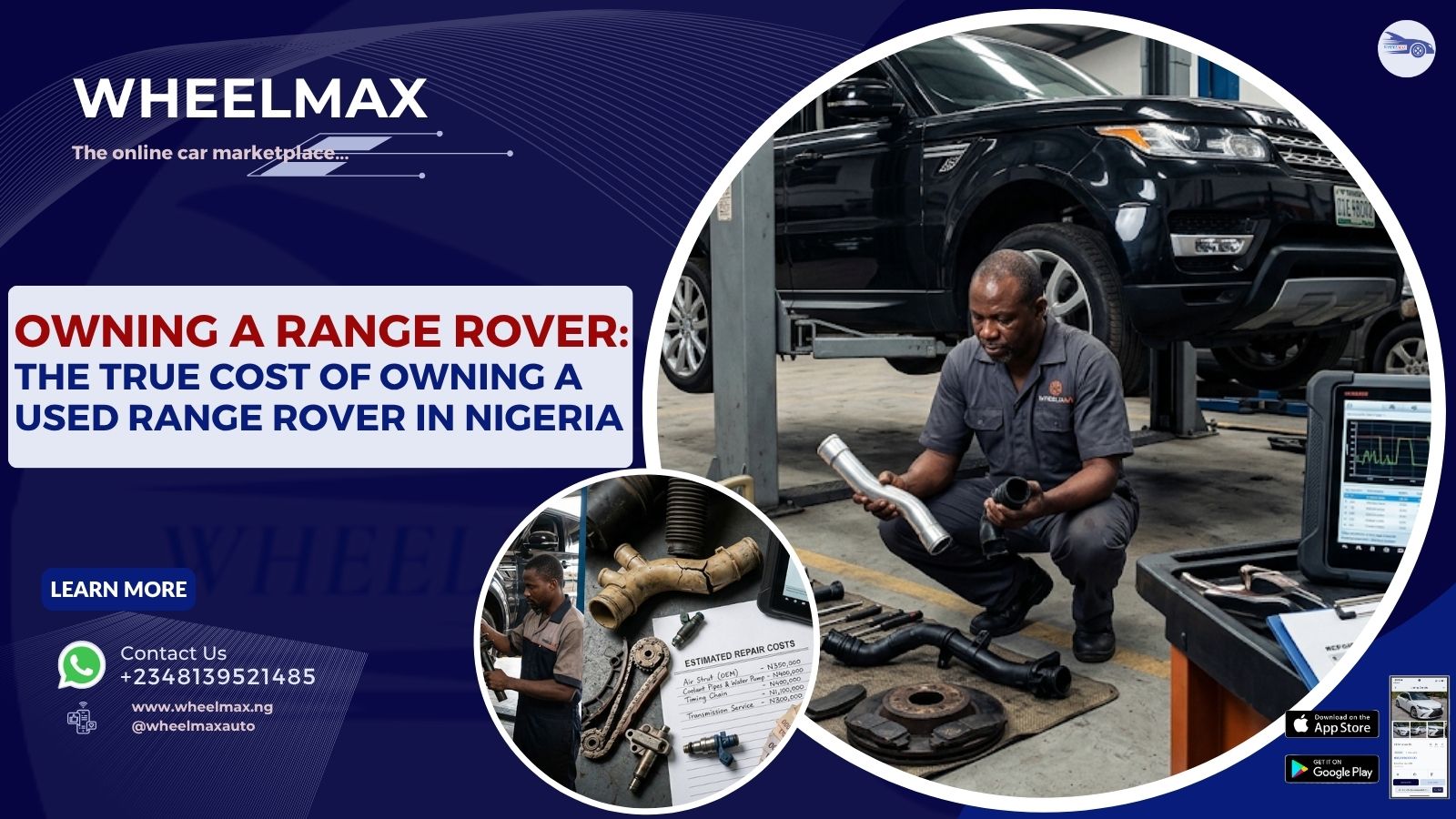
Few automotive badges carry the social weight, road presence, and sheer prestige of a Range Rover in Nigeria. Whether it is a Range Rover Sport sliding through the financial district of Victoria Island or a Range Rover Vogue parked along the boulevards of Maitama, Abuja, stepping out of a Land Rover product sends an unmistakable signal of success.
Thanks to the vibrant foreign-used (tokunbo) car market, models from the 2012 - 2018 era, particularly the Range Rover Sport (L494) and the full-size Vogue (L405), are readily accessible. To an aspiring buyer with N30 million to N50 million in hand, purchasing a pre-owned Range Rover often looks like an extraordinary bargain compared to spending the same amount on a brand-new, entry-level Japanese crossover.
However, many buyers fall victim to the "Used Luxury Trap."
While the purchase price of an older Range Rover depreciates dramatically over time, the cost of its replacement parts, fluids, electronic modules, and specialized labor remains calibrated to a vehicle that originally retailed for $90,000 to $140,000.
If you are considering buying a used Range Rover in Nigeria, you need more than enthusiasm, you need cold, hard numbers.
Below is an honest, data-driven look at the real-world financial commitments required to keep a used Range Rover running reliably on Nigerian roads.
1. The Daily Reality: Fuel Appetite
Unless you manage to find a rare 2.0-liter 4-cylinder variant, the vast majority of used Range Rovers in Nigeria are powered by two Jaguar Land Rover engines:
1. The 3.0-Liter Supercharged V6 (AJ126): ~340 hp to 380 hp
2. The 5.0-Liter Supercharged V8 (AJ133): ~510 hp to 550 hp
Both engines are supercharged, direct-injection powerhouses designed for performance. In open European highway conditions, their fuel consumption is manageable. In the stop-and-go, high-idle reality of Nigerian urban traffic, their fuel consumption is astronomical.
Realistic Fuel Figures in Nigerian Conditions
1. 3.0L Supercharged V6: Averages between 14 and 18 Liters per 100 km in city traffic (roughly 5.5 to 7.1 km per Liter).
2. 5.0L Supercharged V8: Averages between 18 and 24 Liters per 100 km in dense city gridlock (roughly 4.1 to 5.5 km per Liter).
The Monthly Fuel Bill Breakdown
A Range Rover Sport or Vogue features a fuel tank capacity of roughly 85 to 105 Liters.
1. Filling an empty 90-liter tank from empty requires significant capital per fill-up at current fuel pump prices.
2. If you commute 30 to 40 kilometers daily in Lagos or Abuja traffic, expect to burn through at least two full tanks of petrol every month.
3. Monthly Fuel Budget: Budget between N180,000 and N320,000 per month purely for fuel, depending on your displacement and daily route.
Furthermore, these high-compression supercharged engines are deeply sensitive to fuel quality. Low-octane or contaminated fuel triggers spark knock (pre-ignition), forcing the engine control computer to retard timing, which robs you of power and spikes your fuel consumption even higher.
2. Routine Maintenance: Scheduled Servicing
Routine maintenance on a Range Rover cannot be handled with generic supermarket lubricants or roadside mineral oils.
Engine Oil & Filters (Every 6,000 - 7,500 km)
The 3.0L and 5.0L engines require a massive oil capacity of 8.0 to 8.5 liters of specialized synthetic oil meeting strict Jaguar Land Rover specifications (e.g., STJLR.03.5004 or Ford WSS-M2C925-A).
1. The Fluids: 9 bottles of high-grade 0W-20 or 5W-20 full-synthetic oil.
2. The Filters: One dedicated canister oil filter, plus two engine air filters (these engines utilize dual air intake boxes) and a micro-cabin filter.
3. Estimated Routine Service Cost: Budget between N110,000 and N160,000 for a single basic oil and filter service.
Drivetrain Fluids (Every 40,000 – 50,000 km)
1. ZF 8-Speed Automatic Transmission: Requires specialized ZF Lifeguard 8 transmission fluid and a replacement transmission sump pan (which features an integrated micro-filter). A proper drain and fill costs between N250,000 and N400,000.
2. Transfer Case & Differential Fluids: Front, center, and rear electronic locking differentials require heavy gear oils changed at major intervals. Expect N90,000 to N140,000 for a complete gear-oil refresh.
3. The "Big Four" Unscheduled Repairs in Nigeria
Beyond routine oil changes, every used Range Rover operating in Nigeria will eventually face four major mechanical failure points. These are not manufacturing defects, they are age-related and environmental wear points that every owner must budget for:
Failure Point 1: The Plastic Coolant Crossover Pipe Disaster
1. The Issue: Underneath the supercharger manifold on the 3.0L V6 and 5.0L V8 sit front and rear molded-plastic coolant crossover pipes. Over 5 to 7 years of intense engine bay heat cycles, the plastic becomes as brittle as potato chips and snaps without warning.
2. The Danger: Coolant empties within seconds. Because these are all-aluminum engines, even 60 seconds of severe overheating will warp the cylinder heads or crack the engine block.
3. The Repair Cost: Replacing these crossover pipes proactively (often upgrading to aftermarket aluminum seamless pipes), along with the water pump, thermostat housing, and supercharger snout gasket, costs between N350,000 and N600,000 (parts and specialized labor).
Note: If the engine overheats and seizes, a replacement used (tokunbo) 3.0L/5.0L engine costs between N7,000,000 and N13,000,000.
Failure Point 2: Electronic Air Suspension (EAS) System
1. The Issue: The plush "magic carpet" ride of a Range Rover is delivered by air struts inflated by an onboard compressor. Nigerian heat degrades the rubber air bellows, while deep road craters accelerate rubber cracking.
2. The Symptoms: The car "kneels" or droops on one corner overnight, or displays the dreaded amber message: "Suspension Fault: Normal Height Only."
3. The Repair Cost:OEM-grade front air strut replacement: N250,000 – N450,000 per corner.
4. Rebuilt/OEM Hitachi or AMK suspension compressor: N300,000 – N550,000.
5. Valve blocks and height sensors: N80,000 – N150,000.
Failure Point 3: Timing Chain & Tensioner Wear
1. The Issue: The factory timing chain guides on 2012–2015 models feature aluminum backings with thin plastic faces that wear down prematurely, especially if previous owners neglected oil changes.
2. The Symptoms: A sharp, metallic rattling sound on the front of the engine for 3 to 5 seconds upon a cold start.
3. The Repair Cost: Replacing timing chains, guide rails, hydraulic tensioners, and cam phasers is a high-skill, engine-out or front-clip-off procedure. Budget N800,000 to N1,500,000 for a full timing chain overhaul using genuine parts.
Failure Point 4: Heavy-Duty Brakes and 21"/22" Tires
1. The Issue: Bringing a 2.3-ton luxury SUV to a safe stop from 100 km/h requires massive multi-piston Brembo brake calipers and oversized vented rotors. Furthermore, the low-profile tires fitted to large alloy wheels are vulnerable to impact blowouts on potholes.
2. The Costs:
3. Front and rear ceramic/semi-metallic brake pads plus electronic wear sensors: N120,000 - N190,000.
4. Front brake disc rotors (pair): N180,000 - N300,000.
5. One high-performance 21-inch or 22-inch tire (e.g., Pirelli, Continental, or Michelin): N180,000 - N350,000 per tire.
4. The Annual Cost of Ownership Profile
To give you an uncompromising picture, here is what a realistic, well-maintained annual budget looks like for a used Range Rover Sport (3.0L V6) driven approximately 15,000 kilometers per year in Nigeria:
Baseline Running Costs (Annual Estimate)
1. Fuel (15,000 km / ~2,500 Liters of PMS): N2,500,000 – N3,200,000
2. Routine Servicing (2 scheduled services per year): N250,000 – N320,000
3. Comprehensive Insurance & Tracking: N350,000 – N600,000
Wear, Tear & Preventative Repairs Reserve (Annual Average)
1. Suspension & Bushings (Air strut, control arms, sway bar links): N400,000 – N700,000
2. Braking System (Pads, sensors, rotor skimming/replacement): N180,000 – N250,000
3. Tire Replacements (Pothole damage / replacement reserve): N350,000 – N500,000
4. Unscheduled Cooling or Electrical Diagnostics Buffer: N300,000 – N500,000
Total Estimated Annual Expenditure: N4,330,000 – N6,070,000
Financial Rule: If spending N350,000 to N500,000 every single month to keep your car operating at peak reliability would cause you significant financial stress, you cannot comfortably afford to own a used Range Rover, even if you have the cash to buy the car outright today.
5. The 3 Golden Rules for Prospective Range Rover Buyers
If you have reviewed the financial numbers and still intend to buy a Range Rover, protect your investment by following these rules:
Rule 1: The "30% Reserve Rule"
Never spend your entire vehicle purchase budget on acquiring the car. If you have N40 million saved, buy a vehicle priced at N28 million to N30 million, and lock the remaining N10 million away in a dedicated maintenance fund. On day one of ownership, you must replace the plastic coolant pipes, flush all fluids, and address worn suspension components before daily use.
Rule 2: Demand a JLR-Specific Diagnostic Pre-Purchase Inspection
Never rely on a general roadside mechanic with a $20 OBD-II scanner. Demand a comprehensive pre-purchase inspection using dedicated Land Rover software (JLR SDD or Pathfinder). This software reads live values from all 25+ internal computer networks, revealing hidden suspension valve leaks, transmission clutch degradation, and historical engine overheating events that generic scanners miss entirely.
Rule 3: Reject "Trial-and-Error" Mechanics
The complex electrical and hydraulic architecture of a Range Rover cannot be serviced by guess-work technicians who "bypass" fan relays, discard thermostats, or cut wire harnesses. Servicing an Evoque, Velar, Sport, or Vogue requires precision torque specs, OEM-approved fluids, and certified diagnostic expertise.
The Final Verdict
A used Range Rover is not an unreliable vehicle; it is an intolerant vehicle.
It does not tolerate delayed oil changes, low-grade fluids, bad fuel, or amateur mechanics. When treated with the mechanical discipline its aerospace-grade engineering requires, it delivers a driving experience, luxury cocoon, and road presence that few automobiles on earth can match.
However, entering Range Rover ownership under the illusion that it will cost the same to maintain as a Japanese commuter SUV is a recipe for heartbreak. Go into the purchase with clear eyes, a fully funded maintenance reserve, and access to verified automotive specialists.
Considering the purchase of a used Range Rover Sport, Vogue, or Velar? Protect yourself from multi-million-Naira hidden faults by booking a computerized Pre-Purchase Inspection with the certified luxury vehicle specialists at Wheelmax today.