
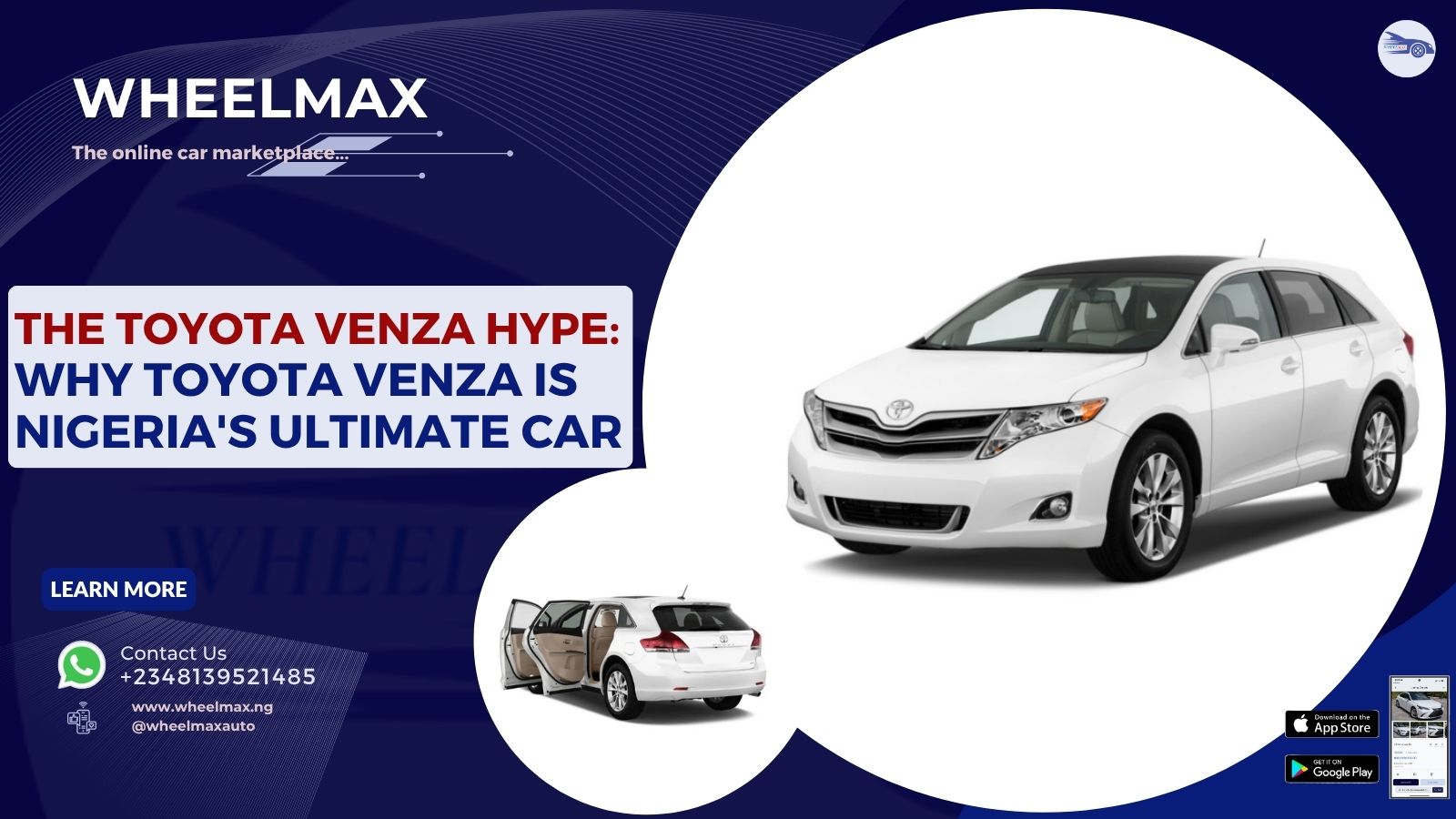
Take a walk down Admiralty Way in Lekki, cruise along Ahmadu Bello Way in Abuja, or navigate the commercial avenues of Port Harcourt, and one automotive reality becomes immediately obvious: the first-generation Toyota Venza owns the road.
When Toyota’s Georgetown, Kentucky plant in the United States produced the first Venza for the 2009 model year, it was designed to appeal to suburban North American drivers who wanted a crossover that was more athletic than a minivan and more practical than an executive saloon.
However, when these vehicles began arriving at Nigerian seaports as foreign-used (tokunbo) imports, something extraordinary happened. The Venza evolved from a practical American family wagon into an undisputed Nigerian cultural phenomenon. It became the signature vehicle for upwardly mobile executives, tech founders, entertainment figures, and modern families alike.
More than a decade after its original debut, the Venza remains the most liquid, sought-after, and celebrated tokunbo crossover on Nigerian roads.
What makes this American-built Japanese crossover so dominant in Nigeria? The answer lies in four distinct pillars: distinctive styling, Camry-derived reliability, bulletproof V6 performance, and an exceptionally spacious cabin.
1. Distinctive Styling & Stance: SUV Clearance Meets Saloon Elegance
Before the Venza arrived, Nigerian car buyers had to make a compromise. If you wanted style and highway stability, you bought a sedan like the Toyota Camry or Honda Accord - and scraped your undercarriage over municipal speed bumps and flooded gutters. If you wanted ground clearance, you bought a tall, boxy SUV like the Toyota RAV4 or Highlander.
The Venza completely dismantled this compromise.
The 8.1-Inch Clearance Advantage
The Venza sits on a generous 205 mm (8.1 inches) of factory ground clearance. That is identical to—and in some cases higher than—dedicated mid-size SUVs. It navigates deep rainy-season puddles, uneven bridge expansion joints, and unpaved estate access roads without scratching its exhaust pipes or bumpers.
Imposing Road Presence
With its wide, planted track, sweeping aerodynamic roofline, and flared rear quarter panels, the Venza looks muscular without being boxy.
1. The 20-Inch Alloy Factor: Factory V6 models come fitted with bold, 20-inch split-spoke aluminum alloy rims. In a market where curbside presence and social status matter, these oversized factory wheels give the Venza an authoritative, premium stance right out of the shipping container.
2. The Panoramic Vista: Models equipped with the dual-pane panoramic glass roof offer an upscale, European aesthetic that makes the car look significantly more expensive than its pre-owned purchase price suggests.
2. Camry-Based Mechanicals: The "Ladipo Factor"
The secret behind the Venza's longevity in Nigeria is hidden beneath its sculpted sheet metal.
The Venza was engineered on Toyota’s modular K-platform, meaning it shares structural bones, suspension architecture, braking systems, and electrical harnesses with two of Nigeria's most familiar mechanical staples: the XV40 Toyota Camry and the second-generation Toyota Highlander.
Why This Matters in Nigeria:
1. Universal Mechanic Familiarity: You do not need an overpriced specialist or specialized dealership software to perform routine repairs on a Venza. From Ladipo and Trade Fair in Lagos to Apo Mechanic Village in Abuja, virtually every technician knows how to service its braking calipers, change its suspension struts, and troubleshoot its onboard systems.
2. Unmatched Spare Parts Availability: Because its steering tie rods, brake pads, wheel bearings, oxygen sensors, and alternators are identical to those found on millions of Camrys, Highlanders, and Lexus RX 350s, parts availability is virtually 100% nationwide. You will never have to park your car for three weeks waiting for an air-freighted component from overseas.
3. Affordable Maintenance Overhead: Parts competition among importers keeps replacement prices low. Whether you need an OEM ball joint or an original oil filter, components are accessible and affordable.
3. The 3.5L 2GR-FE V6: Smooth, Effortless Muscle
While Toyota offered an entry-level 2.7-liter 4-cylinder engine (1AR-FE), the vast majority of desirable tokunbo Venzas imported into Nigeria feature the celebrated 3.5-liter naturally aspirated 2GR-FE V6.
Powertrain Snapshot:
1. Horsepower: 268 hp @ 6,200 RPM
2. Torque: 246 lb-ft (334 Nm) @ 4,700 RPM
3. Transmission: 6-Speed Electronically Controlled Automatic (U660E)
4. Timing System: Internal heavy-duty steel timing chain
Why the V6 Conquered Nigerian Highways:
1. Effortless Expressway Overtaking: The 268-horsepower V6 provides immediate, muscular acceleration. When executing high-speed overtakes past articulated long-haul trucks on interstate corridors like the Lagos–Ibadan Expressway or Benin–Asaba bypass, a tap of the throttle delivers instant, confidence-inspiring passing power without gear hunting.
2. Internal Timing Chain Longevity: Unlike rival engines that use rubber timing belts requiring replacement every 100,000 kilometers, the 2GR-FE utilizes a heavy-duty internal steel timing chain engineered to last the operating lifetime of the engine (provided oil changes are maintained).
3. Under-Stressed Cruising: In a heavy vehicle weighing over 1.8 tons, the powerful V6 engine barely strains to maintain 100–120 km/h cruising speeds, resulting in long-term mechanical durability and a quiet cabin environment.
4. Lounge-Like Interior Architecture: The Limousine Crossover
Step inside a Venza, and its American design philosophy shines. While European crossovers often feel cramped due to dark headliners and narrow sports seats, the Venza was built around horizontal space and airy comfort.
The Flat Rear Floor Pan
Because Toyota opted not to squeeze an unusable third row of seats into the cargo area, second-row passengers are treated to executive-class accommodations:
1. Zero Transmission Tunnel: The rear floor is completely flat. Unlike most crossovers that have a raised hump in the middle, the center passenger in a Venza can sit with their feet planted flat on the floorboard.
2. Reclining Seatbacks: The rear seats recline up to 14 degrees, allowing passengers to lean back and sleep comfortably during long road trips.
The 60/60 Center Console Innovation
The front cockpit features Toyota’s signature "60/60" layout, designed to make both the driver and front passenger feel like 60% of the cabin space is dedicated to them.
1. The gear shifter is mounted high on the dashboard, liberating an enormous amount of floor real estate.
2. The center console features an illuminated, multi-tiered sliding compartment system with dedicated cable pass-throughs for smartphones, deep cup holders, and an armrest bin large enough to swallow a laptop or handbag.
Cavernous Luggage Volume
Even with five full-grown adults seated in comfort, the trunk provides 36.2 cubic feet of cargo room. Fold the spring-loaded 60/40 rear seats flat with the touch of a single trunk-mounted release lever, and the cargo bay expands to 70.2 cubic feet—large enough to haul building supplies, commercial trade inventory, or large home power generators.
5. The Nigerian Market Reality: A Rolling Financial Asset
Beyond comfort, aesthetics, and engineering, the Venza holds a unique financial distinction in Nigeria: unrivaled resale liquidity.
In the Nigerian automotive market, buying a tokunbo car is rarely viewed purely as an expense; it is treated as a store of monetary value. Because the demand for clean, foreign-used Venzas consistently outpaces supply, depreciation in local Naira terms is exceptionally low.
A buyer who purchases a cleanly maintained 2011–2014 Venza today can drive it for two or three years and resell it rapidly, often within 48 hours of posting an advert, recovering the vast majority of their original capital. In an unpredictable economic climate, that level of financial security is priceless.
The Venza Buyer's Checklist: 3 Weaknesses to Inspect
Despite its bulletproof pedigree, the Venza operates in an unforgiving operating environment. Before finalizing your tokunbo purchase, inspect these three localized wear points:
1. Pothole Damage on 20-Inch Rims
The standard 245/50R20 low-profile tires fitted to V6 models have thin sidewalls. Repeated impacts with deep potholes can trigger sidewall bubbles, bent inner wheel rims, or a firm, jarring ride.
The Wheelmax Solution: Many experienced owners downsize their wheel setup to 18- or 19-inch rims wrapped in thicker 55- or 60-series tires for superior pothole cushioning and rim protection.
2. Intermediate Steering Shaft Clunk
Turn the steering wheel from lock to lock while parked, and listen for a subtle knocking or clicking sound beneath the pedals. The splines on the intermediate steering column frequently lose their factory grease coating over time, requiring regreasing or an OEM replacement shaft.
3. V6 Water Pump Seepage
Look behind the serpentine belt on the passenger side of the engine block for dried pink, chalky coolant residue. The 2GR-FE water pump typically begins weeping from its mechanical seal around 130,000 to 160,000 km and should be replaced proactively with an OEM Aisin unit to prevent overheating.
The Wheelmax Verdict
The Toyota Venza didn't become Nigeria's favorite tokunbo car by accident. It earned its crown through a masterclass in market packaging.
It gives you the commanding ground clearance of an SUV without the cumbersome bulk. It delivers the sleek, status-affirming road presence of an executive crossover without the punishing repair bills of a German luxury brand. And it backs it all up with the bulletproof mechanical architecture of the Toyota Camry and Highlander.
When maintained with the correct multigrade synthetic oil (0W-20 or 5W-20), regular transmission fluid flushes, and genuine OEM consumables, a foreign-used Toyota Venza will effortlessly cross 350,000 kilometers on Nigerian roads while retaining its elegance, comfort, and financial value.
It remains, without question, the gold standard of foreign-used motoring in Nigeria.
Planning to buy a 'tokunbo' Toyota Venza? Protect yourself from imported accident wrecks, flood-damaged salvage titles, and hidden water pump leaks. Book an expert computerized Pre-Purchase Inspection (PPI) with Wheelmax today.