
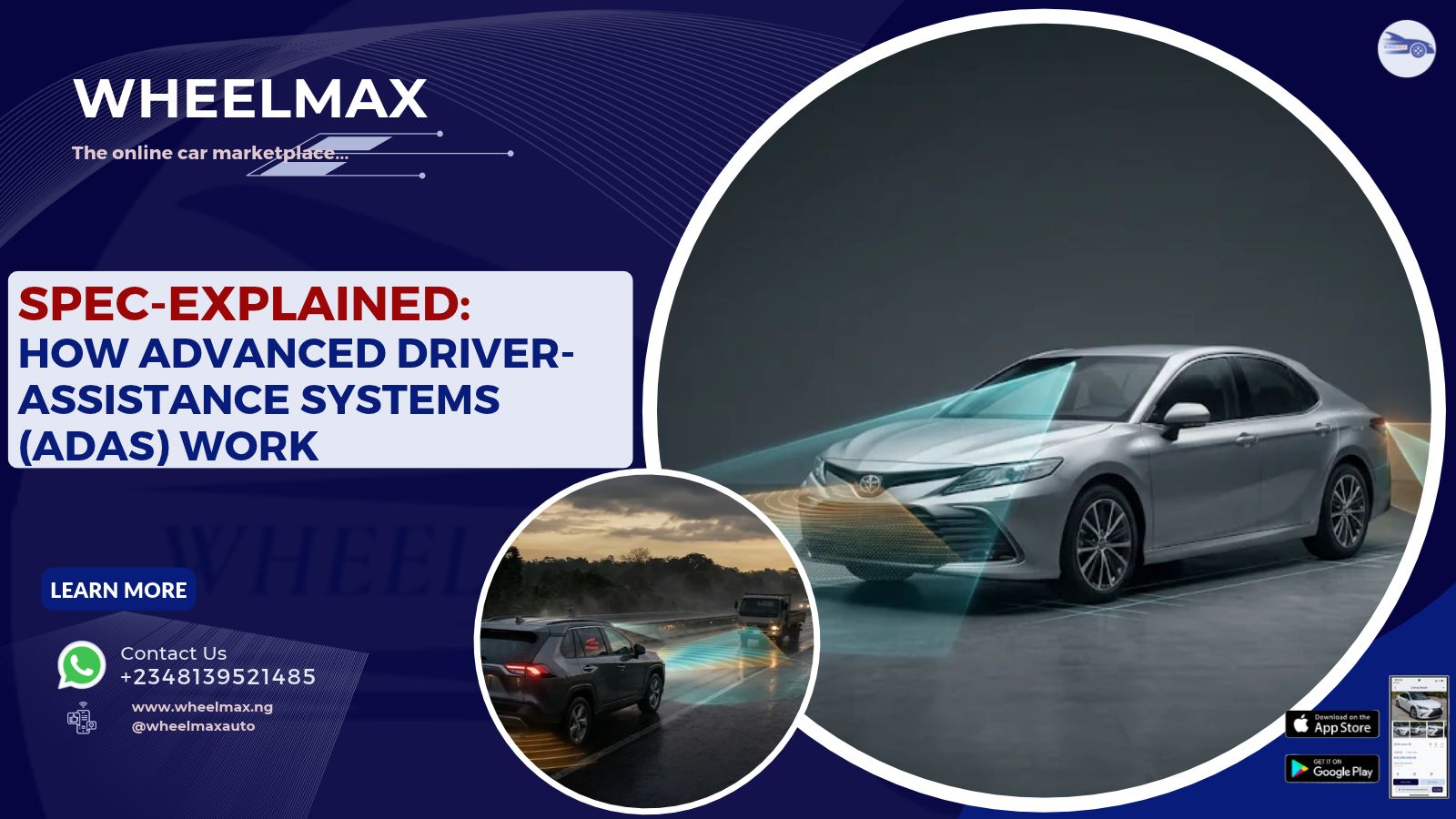
If you have test-driven a modern vehicle or browsed foreign-used (tokunbo) car listings recently, you have likely encountered a dizzying alphabet soup of safety acronyms: AEB, BSM, LKA, ACC, and FCW.
Automakers brand these suites under proprietary names: Toyota Safety Sense (TSS), Honda Sensing, Hyundai SmartSense, Subaru EyeSight, and Mercedes-Benz PRE-SAFE.
Together, these technologies are collectively known as Advanced Driver-Assistance Systems (ADAS).
For decades, automotive safety was passive: seatbelts, reinforced steel crumple zones, and airbags designed to protect you during a collision. ADAS represents an evolutionary leap to active safety: electronic systems that monitor your surroundings in real time to prevent the crash from happening in the first place.
Many Nigerian drivers view these features with skepticism. Some assume ADAS is equivalent to "self-driving" cars that are impractical for local roads, while others worry that the sensors will fail under intense tropical heat or dusty Harmattan conditions.
In this edition of Wheelmax Spec-Explained, we demystify ADAS for the everyday car owner: breaking down how your vehicle "sees" the world, how the core safety features function, and what you need to know about keeping these high-tech systems operational on Nigerian roads.
The Hardware: How Does Your Car Actually "See"?
An ADAS-equipped vehicle does not have human vision; it relies on three complementary sensor types working simultaneously to build a digital map of its environment:

1. Forward-Facing Optical Cameras
Mounted high up on the windshield inside the bracket behind the rearview mirror, these cameras capture video of the road ahead. They are specifically trained by onboard artificial intelligence to detect lane markings, traffic signs, vehicles, cyclists, and pedestrians.
2. Millimeter-Wave Radar
Usually concealed behind the plastic front grille emblem or the lower bumper opening, radar emits radio waves that bounce off solid objects in front of the car. Radar calculates the exact distance and speed of closure between your car and the vehicle ahead. Because it uses radio waves, it can see through torrential downpours, thick dust, and night darkness where optical cameras struggle.
3. Ultrasonic Sensors
These are the small, coin-sized circular "dots" integrated into your front and rear plastic bumper covers. They emit high-frequency sound waves that bounce off nearby obstacles, primarily assisting with low-speed parking maneuvers.
The Core ADAS Features Explained in Plain English
While manufacturers offer dozens of automated safety aids, three core features deliver the highest real-world safety impact on everyday roads:
1. Autonomous Emergency Braking (AEB) & Forward Collision Warning (FCW)
Autonomous Emergency Braking is widely regarded by automotive safety regulators as the most critical vehicle safety innovation since the three-point seatbelt.
How It Works:
Forward Collision Warning acts as your co-pilot. If the radar and camera detect that the vehicle ahead has stopped suddenly and your closure speed is too high, the system immediately intervenes:
1. The Warning Phase: A loud acoustic alarm sounds inside the cabin while a flashing red alert (usually the word "BRAKE!") illuminates on your instrument cluster or Head-Up Display.
2. The Pre-Charge Phase: The vehicle automatically primes the hydraulic brake lines, bringing the brake pads into immediate contact with the rotors so that the instant you touch the pedal, you get 100% stopping power.
3. The Autonomous Braking Phase: If you fail to react - perhaps because your eyes were momentarily diverted or you froze - the onboard computer automatically commands the ABS module to clamp down on the brakes with maximum force to avoid the crash or drastically reduce the impact speed.
Why It Matters in Nigeria:
1. The "Sudden Pothole Brake-Check": Vehicles on expressways routinely slam on their brakes without warning to avoid a massive crater. If your attention lapses for a single second in bumper-to-bumper commuting, AEB prevents an expensive nose-to-tail collision.
2. Unlit Highway Hazards: On dark interstate roads (like the Lagos–Ibadan or Abuja–Keffi corridors), broken-down trucks often sit abandoned without hazard lights or reflective triangles. Radar-based AEB detects these metallic obstructions in the dark before human headlights can fully illuminate them.
2. Blind Spot Monitoring (BSM) & Rear Cross-Traffic Alert (RCTA)
Even when your side mirrors are correctly adjusted, every car has a "blind quarter"—an area over your shoulder where another vehicle becomes invisible.
How It Works:
Radar sensors mounted behind the corners of your rear bumper constantly scan a cone-shaped zone extending roughly 3 to 5 meters back and one lane over:
1. If a vehicle enters your blind spot, a subtle amber or yellow icon illuminates directly on the glass of that side mirror.
2. If you turn on your directional indicator (blinker) to change lanes while an obstacle is in that blind zone, the icon flashes violently and an acoustic chime warns you not to steer across.
The Rear Cross-Traffic Alert (RCTA) Extension:
When reversing out of a narrow commercial parking space or residential gate where parked SUVs block your view of the road, RCTA uses those same rear radars to scan horizontally. It alerts you to approaching cross-traffic long before the oncoming car enters your backup camera's field of view.
Why It Matters in Nigeria:
The "Okada & Dispatch Rider" Shield: Commercial motorcyclists (okadas) and delivery dispatch riders frequently split lanes and pass rapidly on your inside passenger shoulder. BSM tracks these rapid, low-profile movers, preventing lane-change sideswipes that are common in dense city traffic.
3. Lane Departure Warning (LDW) & Lane Keeping Assist (LKA)
Highway fatigue and brief distractions can cause a car to drift unintentionally out of its lane, leading to high-speed head-on or rollover collisions.
How It Works:
The forward-facing optical camera continuously tracks painted white and yellow lane markings on the highway:
Lane Departure Warning (LDW): If your tire touches a lane marker without your turn signal activated, the car alerts you via an audible chime, a dashboard icon, or a tactile vibration through the steering wheel rim.
Lane Keeping Assist (LKA): If you ignore the warning, the electric power steering motor gently applies corrective steering torque to guide the vehicle back into the center of the lane.
The Nigerian Reality Check:
The Unpainted Road Challenge: On poorly maintained or unpainted Nigerian roads, LKA cameras cannot identify lane boundaries, causing the system to deactivate automatically (usually indicated by a gray or amber lane icon on your dash).
When to Turn It Off: On construction bypass roads with temporary, chaotic lane shifts, LKA can sometimes attempt to correct your steering toward old painted lines. Every vehicle with ADAS includes a physical button on the steering wheel or dashboard to turn off steering intervention while leaving other safety features active.
4. Adaptive Cruise Control (ACC) with Stop-and-Go
Traditional cruise control simply locks your vehicle to a fixed speed, which is virtually useless on unpredictable Nigerian expressways.
How It Works:
Adaptive Cruise Control uses the front-facing radar to lock onto the vehicle ahead:
1. You set your desired cruising speed (e.g., 100 km/h) and a preferred following distance (short, medium, or long).
2. If the car ahead slows down to 70 km/h to pass a truck, your car automatically eases off the throttle and applies the brakes to match its speed. Once the path clears, your vehicle accelerates back to 100 km/h automatically.
3. Traffic Jam Assist (Stop-and-Go): Advanced systems can bring your vehicle to a complete stop in creeping bottleneck traffic, holding the brake, and resuming motion with a tap of the accelerator or steering wheel button once traffic moves.
Maintaining ADAS in Nigeria: 3 Critical Rules
Advanced driver aids are brilliant, but they are precision optical and electronic instruments. In Nigeria’s harsh operating climate, you must follow three rules to keep them working accurately:
Rule 1: The Windshield Replacement Trap (Optical Calibration)
The forward-facing ADAS camera sits glued directly behind your windshield. If an expressway stone chip cracks your front glass, you cannot simply install a cheap aftermarket replacement windshield at a roadside stall and drive away.
Why: The camera must look through the glass at a specific optical angle. After installing a new windshield, the camera must undergo a formal diagnostic calibration using digital alignment targets. If the camera is out of alignment by just 1 millimeter, the car may miscalculate braking distances by dozens of meters.
Rule 2: Protect the Front Radar During Body Repairs
Roadside panel beaters and spray painters frequently ruin front-facing millimeter-wave radars:
Never allow a painter to spray thick body paint, metallic clear-coat, or apply heavy fiberglass "bondo" filler over the front grille emblem or lower radar aperture. Paint and body filler absorb radio waves, blinding the radar and throwing an "ADAS Sensor Blocked" warning on your dash.
Rule 3: Keep the Sensor Zones Clean
1. During dry, dusty Harmattan months, fine dust coats the front radar emblem and windshield camera zone.
2. If your dashboard displays a warning that pre-collision features are unavailable, wipe down the windshield wiper sweep zone and clean the front bumper badge before assuming an electrical component has failed.
The Wheelmax Verdict
Advanced Driver-Assistance Systems are not designed to take away the joy of driving, nor are they an excuse for driver negligence. You remain 100% in command and legally responsible for your vehicle at all times.
Instead, think of ADAS as an electronic safety net—a tireless co-pilot that never looks down at a ringing phone, never gets fatigued during a long night drive, and reacts with computational speed when road hazards suddenly appear.
As these active safety suites filter down from high-end luxury models into mainstream tokunbo Toyota Corollas, Honda Civics, and family crossovers across Nigeria, understanding how they work ensures you can leverage their protective power, drive with confidence, and keep your family safe on every road.
Experiencing ADAS warning lights, radar alignment errors, or need camera calibration after a windshield replacement? Book a computerized safety systems health check with the certified technicians at Wheelmax today.