
For decades, car buying in Nigeria followed an unwritten rule: buy a foreign-used (tokunbo) Toyota, Honda, or Lexus.
The logic was simple. Japanese vehicles offered proven durability, replacement parts were available on every street corner, and every mechanic from Ladipo in Lagos to Apo in Abuja understood their mechanical architecture.
However, significant shifts in foreign exchange rates and import tariffs have disrupted this formula:
1. A five- to seven-year-old foreign-used Toyota RAV4, Highlander, or Lexus RX now commands between N30 million and N50 million.
2. At that price point, buyers are purchasing a vehicle with over 100,000 kilometers of prior usage, an expired overseas warranty, worn suspension rubber, and the ever-present risk of undisclosed salvage auction history.
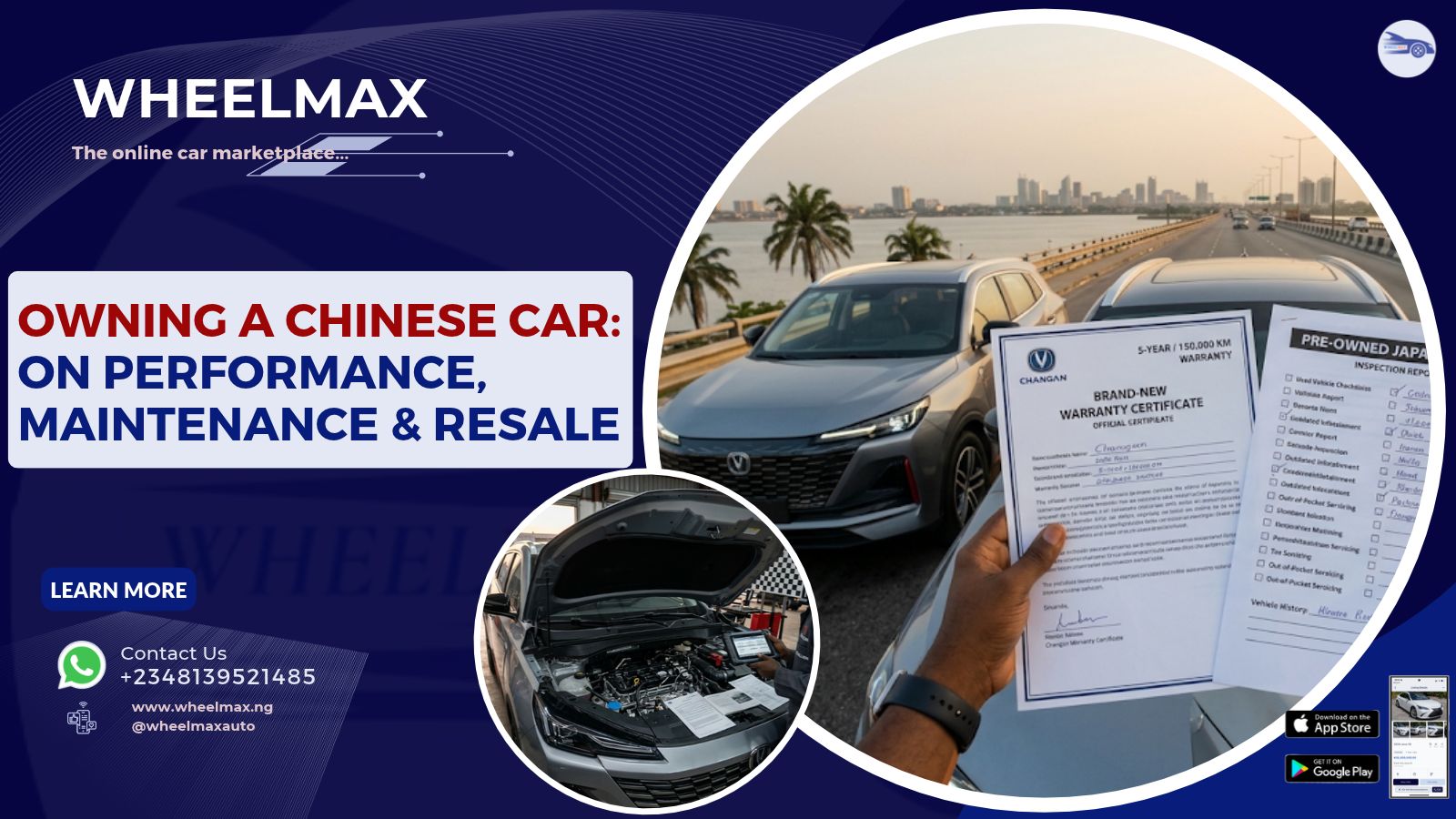
In response, a growing number of Nigerian drivers, corporate fleet managers, and young professionals are looking toward brand-new Chinese crossovers from manufacturers such as Changan, GAC, Geely, and Chery. Supported by local assembly operations and established retail distributors (such as CIG Motors, Stallion Group, Mikano Motors, and Carloha), these vehicles offer zero-mileage reliability, modern design, advanced active safety systems, and manufacturer warranties for the price of a used Japanese crossover.
Yet, widespread skepticism remains: How do these modern vehicles hold up to Nigerian heat, chronic traffic, unpaved roads, and local fuel quality?
Below is an objective, engineering-backed breakdown of what owning a modern Chinese car in Nigeria actually entails - separating showroom marketing from day-to-day mechanical realities.
1. Powertrain Engineering & Nigerian Driving Conditions
Most modern Chinese crossovers in the compact to mid-size segment (such as the Changan CS55 Plus, GAC GS3 Emzoom, Geely Coolray, and Chery Tiggo 7 Pro) are powered by 1.5-liter turbocharged four-cylinder petrol engines paired with 7-speed wet dual-clutch transmissions (DCT).
How Downsized Turbo Engines Perform Locally
The Advantage: These engines produce between 170 and 185 horsepower, with 250 to 300 Nm of torque available from as low as 1,500 RPM. This low-end torque provides brisk, confident highway overtaking on corridors like the Lagos–Ibadan Expressway, outperforming naturally aspirated 2.0L or 2.5L engines while delivering superior open-road fuel economy (typically 6.5 to 7.8 L/100 km).
The Fuel Quality Reality: These powerplants utilize Gasoline Direct Injection (GDI), spraying fuel into the combustion chamber at pressures exceeding 200 bar. GDI engines are sensitive to fuel contamination, water content, and low octane ratings. Running poor-quality petrol can trigger spark knock (pre-ignition), foul high-pressure fuel injectors, and accelerate carbon buildup on intake valves. Owners must purchase fuel from reputable, high-volume retail stations and use high-grade fuel system cleaners periodically.
The 7-Speed Wet DCT in Chronic Traffic
Early iterations of dual-clutch transmissions used "dry" clutches that frequently overheated and shuddered in tropical gridlock. Modern Chinese models in Nigeria largely utilize wet-clutch DCTs, where internal clutch plates are bathed in cooling hydraulic oil.
At Speed (Above 20 km/h): Shifts are quick, crisp, and efficient.
In Low-Speed Traffic (Under 10 km/h): During prolonged, crawling bumper-to-bumper traffic (such as on Third Mainland Bridge or Lekki-Epe Expressway), a dual-clutch system can occasionally feel less elastic than a traditional hydraulic torque-converter automatic. Drivers may feel a subtle mechanical engagement when creeping forward short distances.
2. Suspension, Road Dynamics, and Local Infrastructure
Nigerian road networks subject running gear to severe punishment, from deep potholes and bridge expansion joints to unpaved residential streets and open concrete drainage channels.
Firm Suspension vs. Pothole Resilience
Most Chinese crossovers are tuned to European dynamics: firm spring rates and stiff anti-roll bars designed to keep the vehicle stable at high speeds on smooth tarmac.
The Highway Benefit: Body roll is tightly controlled, and the vehicle feels planted and stable at 110–120 km/h without floating or swaying in crosswinds.
The Pothole Penalty: Paired with standard 18- or 19-inch alloy wheels and low-profile tires, this firm setup transmits sharp, jarring thuds into the cabin when dropping into abrupt road craters. Unlike older body-on-frame SUVs with tall tire sidewalls that absorb impacts, drivers of modern crossovers must actively scan the road to avoid wheel and tire sidewall damage.
The Practical Value of 360-Degree Cameras
A major engineering asset of modern Chinese vehicles is their camera suites. Many models feature high-definition 360-degree cameras with a virtual "transparent chassis" function.
1. On tight, car-lined streets flanked by open concrete gutters, the center display shows a real-time rendering of the ground directly beneath the vehicle.
2. This allows drivers to monitor the precise position of their tires and oil pan relative to curbs and gutters, significantly reducing low-speed parking scrapes and suspension drops.
3. Maintenance, Spare Parts & Workshop Infrastructure
The long-term ownership experience of any car depends directly on its supply chain and mechanic familiarity. This is the area where Chinese vehicles present the most distinct trade-offs.
The Dealer Network vs. The Open Market
Fast-Moving Consumables: Routine service items—such as engine oil filters, air filters, cabin microfilters, and brake pads—are readily available through authorized distributors and an increasing number of specialized independent merchants in Lagos and Abuja.
Accident and Structural Parts: The open spare parts markets (Ladipo, Trade Fair, Apo) do not yet stock deep inventories of body panels, headlamp assemblies, suspension arms, or electronic control units for Chinese brands. If a vehicle suffers accident damage, replacement panels must often be ordered through official dealership channels, which can involve lead times ranging from several days to several weeks.
The Technical Diagnostic Gap
Modern Chinese vehicles feature complex CAN-bus networks, electronic steering racks, and Advanced Driver-Assistance Systems (ADAS).
1. Traditional roadside mechanics who troubleshoot issues by ear, attempt to bypass cooling fans, or use basic generic code readers often misdiagnose these systems.
2. Maintaining these vehicles requires certified technicians equipped with manufacturer-level bi-directional diagnostic scanners and a strict commitment to 0W-20 or 5W-30 full synthetic engine oil.
4. Financial Comparison: Brand-New Chinese vs. 'Tokunbo' Japanese
When evaluating the financial commitment of vehicle ownership over a four- to five-year cycle, the equation balances out differently across key categories:
5. The Decision Framework: Is a Chinese Car Right for You?
Choosing between a brand-new Chinese crossover and a pre-owned Japanese vehicle depends on your driving habits, location, and financial strategy:
A Modern Chinese Car Makes Sense If:
You want zero-mileage peace of mind: You want to avoid the risks of concealed flood or structural crash damage common among imported salvage vehicles.
You plan to keep the car for 4 to 6 years: Holding the vehicle through its factory warranty window neutralizes early depreciation and protects your capital from major mechanical failures.
You commute primarily in metropolitan centers: You live and work in urban hubs like Lagos, Abuja, or Port Harcourt, where authorized distributor service centers and high-grade fuel stations are readily accessible.
You value modern safety and digital tech: You want high-definition surround cameras, blind-spot monitoring, and modern digital interfaces without paying luxury-brand premiums.
You Should Stick to a Pre-Owned Japanese Car If:
You operate in remote or rural locations: If your daily driving takes you far from authorized service hubs, relying on local mechanics and open-market parts remains essential.
You navigate severe, unpaved off-road terrain: If your daily route involves unpaved mud tracks, rocky surfaces, and deep rural ruts, a traditional body-on-frame SUV with high-profile tires will absorb more physical punishment.
You replace your car every 1 to 2 years: If you treat your vehicle as liquid capital to be turned over quickly, Toyota and Lexus still command faster resale liquidity in Nigeria.
The Wheelmax Perspective
The Chinese automotive industry is following the same evolutionary path that Japanese brands navigated in the 1970s and South Korean brands mastered in the 2000s: trading early market skepticism for competitive engineering, superior standard equipment, and aggressive pricing.
Modern Chinese cars are no longer fragile experiments; they are globally engineered, technologically sophisticated vehicles that provide a viable, warranty-backed alternative to an increasingly expensive used car market.
While buyers must remain mindful of fuel quality discipline, suspension firmness over potholes, and dealer-dependent parts logistics, their value proposition for urban Nigerian drivers is undeniable.
Considering a new or late-model vehicle? From comprehensive Pre-Delivery Inspections (PDI) to computerized diagnostics and factory-grade servicing, maintain your vehicle to the highest standards with Wheelmax.