
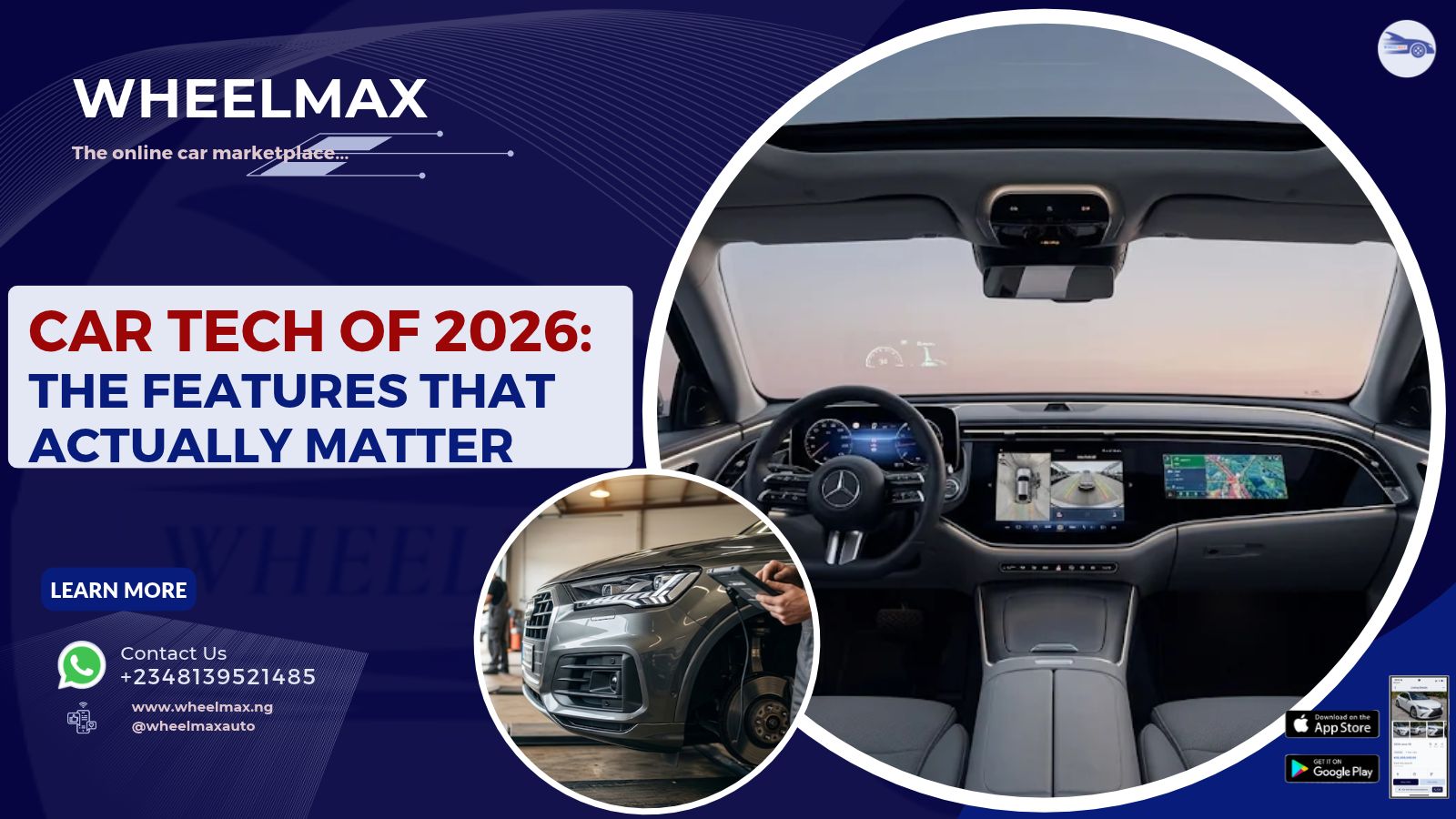
Step into any modern vehicle showroom in 2026, and you will quickly realize that the automobile has transformed from a mechanical machine into a rolling supercomputer.
Automakers are locked in an aggressive tech arms race. Dashboards are now dominated by pillar-to-pillar touchscreens, ambient lighting systems mimic five-star lounges, and spec sheets overflow with complex acronyms: ADAS, LiDAR, OTA, V2X, and AR-HUD.
However, in the Nigerian driving environment, there is often a massive disconnect between what looks impressive in a glossy promotional video and what actually delivers value on our roads. A feature designed for a glass-smooth autobahn in Germany or an eight-lane highway in California can quickly become a useless, or irritating, gimmick when faced with the unpredictability of Third Mainland Bridge gridlock, deep road craters, unlit interstate expressways, and aggressive commercial traffic.
At Wheelmax, we believe technology should solve real problems, enhance safety, and reduce the friction of daily ownership.
Here is our definitive, engineering-backed guide to the car tech of 2026: separating the life-saving innovations that truly matter on Nigerian roads from the marketing fluff you can safely ignore.
1. 360-Degree Surround-View Cameras: The Urban Bodyguard
If there is one piece of technology that pays for itself within forty-eight hours of driving in Lagos, Abuja, or Port Harcourt, it is the 360-degree surround-view camera system.
How It Works:
Using four ultra-wide-angle cameras mounted in the front grille, under both side mirrors, and above the rear license plate, an onboard graphics processor stitches the video feeds together in real time to project a seamless, bird's-eye overhead view of your vehicle on the center display.
Why It Matters in Nigeria:
1. The "Uncovered Gutter" Defense: Deep, concrete drainage gutters line thousands of Nigerian residential and commercial streets. Misjudging your passenger-side tire by three inches while pulling over can drop your wheel into an open gutter, snapping lower control arms and tie rods. A 360-degree camera lets you see your exact wheel distance from the curb.
2. Maneuvering Commercial Traffic: Navigating through tight bottlenecks surrounded by commercial minibuses (danfos), delivery motorcycles (okadas), and tricycles (kekes) requires millimetric precision. Surround-view cameras eliminate the driver's blind zones around the front bumper and lower doors.
3. Protecting Expensive Alloy Rims: Curb rash devalues wheels and tears low-profile tire sidewalls. High-definition perimeter cameras let you parallel park with total confidence without grinding your rims against high curbs.
2. Advanced Driver Assistance Systems (ADAS): The Lifesavers
Advanced Driver Assistance Systems utilize radar, ultrasonic sensors, and forward-facing optical cameras mounted behind the rearview mirror to actively monitor your surroundings. While full autonomous driving remains impractical for unmarked Nigerian roads, two specific ADAS features have become indispensable safety assets:
Blind Spot Monitoring (BSM) with Rear Cross-Traffic Alert
1. The Nigerian Reality: Commercial motorcyclists and dispatch riders frequently split lanes and overtake on the inside shoulder at high speeds.
2. The Benefit: BSM illuminates an amber LED warning icon directly on your side mirror (or sounds an acoustic tone) the moment an okada enters your blind quarter. When backing out of a blind commercial parking lot onto a busy street, Rear Cross-Traffic Alert scans perpendicular traffic and warns you of approaching vehicles before you can physically see them.
Autonomous Emergency Braking (AEB) & Forward Collision Warning
1. The Nigerian Reality: Sudden, unprovoked stops are a daily hazard. A preceding vehicle may brake violently to dodge a crater-sized pothole, or an unlit, overloaded truck may stall abruptly on a dark expressway.
2. The Benefit: If your attention lapses for a single second in bumper-to-bumper traffic, radar-based AEB detects the rapid rate of closure, sounds an immediate alert, and pre-charges or automatically applies the hydraulic brakes to prevent a nose-to-tail collision.
Wheelmax Tech Advisory: Some ADAS features, such as Lane Keep Assist (LKA), rely heavily on painted road lines. On unpainted or eroded Nigerian tarmac, basic LKA systems can behave erratically as they search for road markings. In 2026 vehicles, look for systems that allow you to toggle off steering interventions while keeping forward collision detection active.
3. Wireless Apple CarPlay and Android Auto: The Navigation Lifeline
Automakers have spent decades trying to build proprietary built-in satellite navigation systems. On Nigerian roads, almost all of them are obsolete the moment the car rolls off the showroom floor.
Factory OEM navigation maps rarely feature local street updates, cannot account for newly created military checkpoints, and have no visibility into sudden flash floods or informal traffic diversions.
Why Smartphone Integration is King:
1. Crowdsourced Live Traffic: Google Maps and Waze remain the undisputed navigation authorities in Nigeria. They process real-time crowdsourced telemetry from millions of smartphones, routing you around gridlock before you get trapped.
2. The Wireless Revolution: In 2026, premium vehicles have done away with messy USB cables. Wireless Apple CarPlay and Android Auto link your smartphone to the vehicle's infotainment system the moment you step inside with the key. Paired with a Qi-standard wireless charging pad, your phone charges and projects live navigation without overheating loose cables or wearing out charging ports.
3. Voice Control That Works: Proprietary in-car voice systems notoriously struggle to understand Nigerian accents and local street names. Apple’s Siri and Google Assistant leverage cloud-based artificial intelligence, allowing you to dictate messages, change playlists, or search for destinations hands-free without taking your eyes off the road.
4. Direct Tire Pressure Monitoring Systems (TPMS) with Live Readouts
Tires are the most critical safety component on your car, yet they are subjected to brutal punishment in Nigeria: scorching asphalt temperatures, sharp construction debris, and erratic roadside vulcanizers who overinflate tires using guesswork.
The Tech That Matters: Direct vs. Indirect TPMS
1. Indirect TPMS (The Cheap Setup): Uses ABS wheel speed sensors to guess if a tire is flat based on rolling diameter. It only alerts you after a tire has lost substantial pressure.
2. Direct Digital TPMS (The Must-Have): Features individual battery-powered radio sensors mounted inside each wheel valve stem that transmit real-time PSI and tire temperature directly to your digital instrument cluster.
Why It Matters:
As you drive at 110 km/h on an inter-state expressway in 36°C afternoon heat, internal tire pressure rises significantly. If a tire is punctured by a nail or was over-inflated to 50 PSI by a roadside vulcanizer, the combination of excess pressure and heat drastically increases the risk of a high-speed blowout.
Direct TPMS allows you to monitor heat and pressure spikes continuously, giving you plenty of time to pull over safely before a tire delaminates.
5. Adaptive Matrix LED Headlights & Digital Rearview Mirrors
Driving outside major Nigerian cities after sunset can be perilous. Interstate corridors frequently lack functioning streetlights, and broken-down articulated trucks often sit abandoned in active lanes without reflective warning triangles.
Adaptive Matrix LED Headlamps
Unlike basic automatic high beams that simply switch between low and high beam, Matrix LED headlights utilize an array of individually controlled light-emitting diodes:
1. They illuminate the road shoulder and distant hazards with high-beam brightness while digitally creating a "shadow box" around oncoming vehicles.
2. You gain maximum illumination to spot pedestrians, livestock, and road craters in the dark without blinding oncoming drivers.
Digital Full-Display Rearview Mirrors
Using a high-mounted, hydrophobic camera installed inside the rear spoiler, digital mirrors project an unobstructed, wide-angle video feed directly onto the rearview mirror glass:
Overcoming Cargo & Tints: If your trunk is packed to the ceiling with travel luggage or your rear window has dark privacy tint, your view is completely unaffected.
Night Glare Cancellation: Digital processing dynamically dims the blinding high beams of following vehicles, preventing night-time eye fatigue.
The Gimmick Filter: 3 Overhyped Features You Don't Need
Not all 2026 automotive technology deserves your hard-earned money. Here are three features that add complexity and repair costs without delivering real-world utility in Nigeria:
1. Gesture Controls
The Reality: Systems that allow you to twirl your finger in the air to adjust the audio volume or swipe to answer calls are fundamentally unreliable. Bumping along uneven road surfaces leads to accidental volume spikes, and the sensors frequently fail to register deliberate movements. A traditional physical knob on the dashboard remains superior in every metric.
2. All-Touch Climate Controls (No Physical Buttons)
The Reality: Automakers love touch-only climate screens because they are cheaper to manufacture than physical plastic switches. But trying to adjust the fan speed or temperature on a smooth glass screen while driving over potholes forces you to take your eyes off the road for several dangerous seconds. Tactile rotary dials and mechanical buttons are safer and more durable.
3. Proprietary In-Car Satellite Navigation
The Reality: Never pay extra for factory navigation map updates. Without real-time crowdsourced traffic data, factory systems will reliably direct you straight into the worst traffic jams in town. Stick to Apple CarPlay or Android Auto.
The Maintenance Reality: Maintaining High-Tech Cars in Nigeria
Modern vehicle tech delivers immense safety and convenience, but it fundamentally changes vehicle maintenance:
1. Windshield Replacements Aren't Simple Anymore: If a stone thrown up on the expressway cracks your windshield, you cannot simply install a cheap piece of glass at the roadside. The forward-facing ADAS camera mounted to the windshield must be digitally calibrated using specialized optical targets. A misaligned camera will cause your emergency braking system to malfunction.
2. Bumper Repairs Require Radar Alignment: Even a minor rear-end or front-bumper tap can knock millimeter-wave radar sensors out of alignment, triggering dashboard fault codes and disabling your cruise control and blind-spot monitors.
3. Battery Health is Mission-Critical: High-tech 2026 vehicles feature over 30 interconnected Electronic Control Units (ECUs). An aging or weak 12V battery will trigger a cascade of false electronic fault codes across the dashboard.
The Wheelmax Verdict
The automotive technology of 2026 has the power to make driving on Nigerian roads safer, less stressful, and vastly more enjoyable - provided you invest in features engineered for utility rather than novelty.
Prioritize vehicles equipped with 360-degree cameras, robust radar-based blind-spot monitoring, wireless smartphone projection, direct TPMS, and advanced LED lighting. These systems actively protect you from the physical realities of our road infrastructure. Leave the gimmicky gesture controls and touch-only climate sliders behind.
As vehicles become more sophisticated, maintaining them requires specialized diagnostic capability, precision calibration tools, and technicians who speak the language of modern electronics.
Driving a modern, tech-forward vehicle? From computerized ADAS radar calibration and electronic troubleshooting to high-voltage battery health checks, ensure your car's advanced systems are maintained by certified specialists at Wheelmax.