
For many Nigerian car buyers, the desire to own a German automobile is strong. German engineering represents solid highway composure, heavy sheet metal, crisp steering feedback, and an understated executive presence that Japanese commuter cars often struggle to match.
However, the cost of acquiring and maintaining a modern Mercedes-Benz C-Class or BMW 3 Series can be financially daunting.
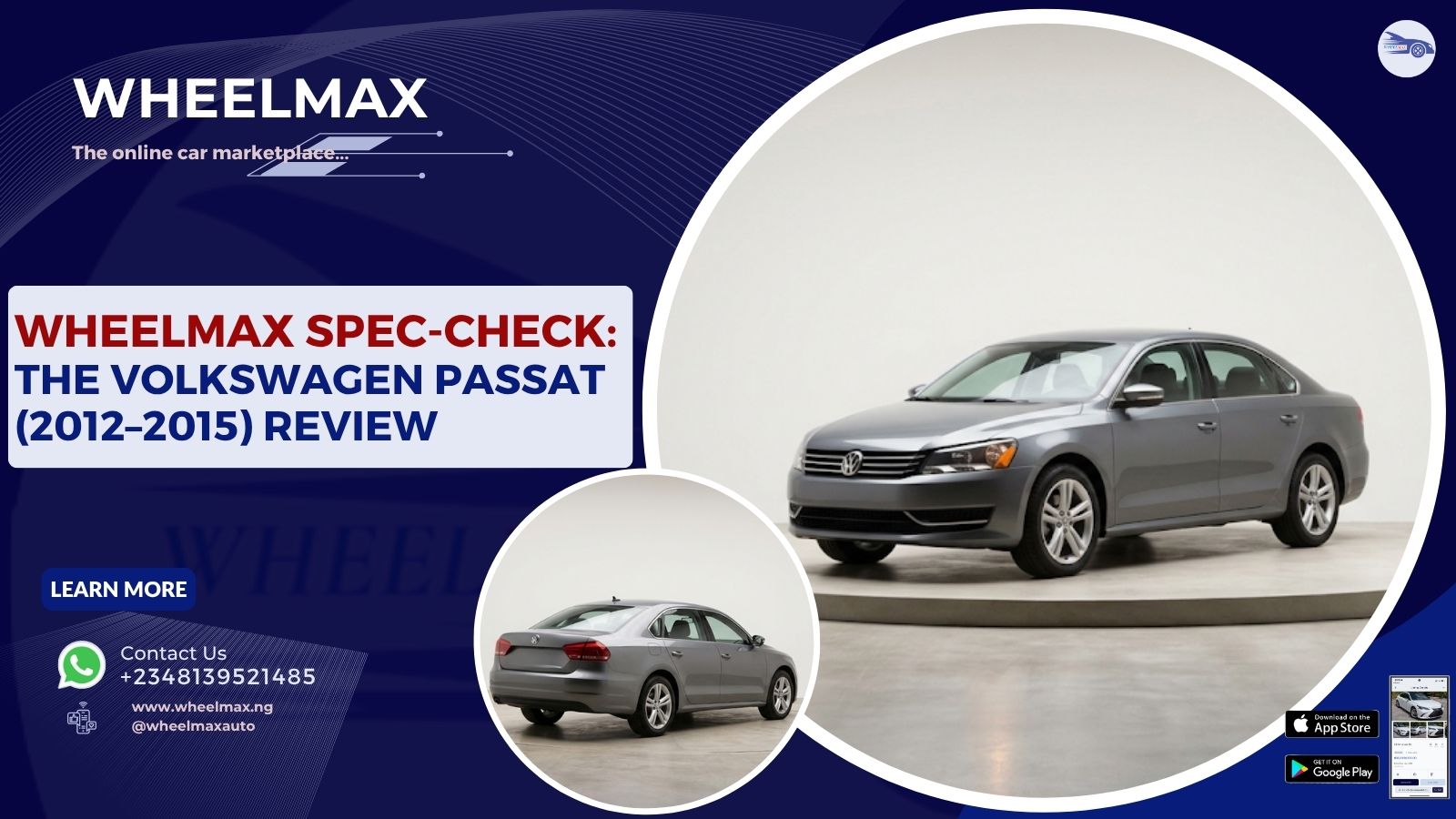
Enter the 2012–2015 Volkswagen Passat.
Specifically designed for the North American market and built at Volkswagen’s state-of-the-art assembly plant in Chattanooga, Tennessee, this generation of the Passat (internally designated the NMS or New Midsize Sedan) was engineered to beat the Toyota Camry and Honda Accord at their own game. It offered a stretched wheelbase, a cavernous rear cabin, and a compliant, comfort-tuned suspension, all while retaining unmistakable German driving dynamics.
Arriving in large numbers across Nigeria as foreign-used (tokunbo) imports, the 2012-2015 Passat has become the ultimate "hack" for drivers seeking affordable German luxury.
In this comprehensive Wheelmax Spec-Check, we deliver an honest, engineering-focused review of the 2012–2015 Volkswagen Passat: its executive comfort, engine choices, local maintenance requirements, and what it truly takes to run one reliably in Nigeria.
1. Exterior Design & Stance: Timeless, Understated Presence
Unlike modern sedans with aggressive swoops and sharp styling creases that quickly look dated, the 2012–2015 Passat embraces a clean, horizontal three-box German design.
Key Dimensions & Exterior Specs:
1. Overall Length: 4,868 mm (191.7 inches)
2. Overall Width: 1,835 mm (72.2 inches)
3. Wheelbase: 2,803 mm (110.4 inches) – significantly longer than the European B7 Passat
4. Ground Clearance: 145 mm (5.7 inches)
5. Standard Wheel Sizes: 16-inch steel/alloys (S/SE) to 18-inch multispoke alloys (SEL Premium)
The Nigerian Road Reality:
1. Highway Stance: The Passat sits planted on the asphalt. At 120 km/h on expressways like the Lagos–Ibadan or Abuja–Kaduna corridors, it exhibits zero floating sensations, crosswind twitchiness, or road jitter.
2. Ground Clearance Consideration: With 5.7 inches of ground clearance, it is a low-riding European sedan. While it glides over well-paved highways, navigating oversized municipal speed bumps or unpaved inner-city access roads requires angled approaches to avoid scraping the front plastic air dam or catalytic converter heat shields.
2. Interior Space: The "Limousine-Class" Secret
The single greatest selling point of the American-spec NMS Passat is its interior packaging. Volkswagen specifically stretched the chassis between the front and rear wheels to create class-leading legroom.
Unrivaled Rear-Seat Legroom
The rear seat of the 2012–2015 Passat offers an astonishing 39.1 inches of rear legroom. That is more rear passenger space than an equivalent-year Mercedes-Benz E-Class, BMW 5 Series, or Toyota Camry. A 6-foot-tall passenger can comfortably cross their legs behind a 6-foot-tall driver without their knees touching the front seatback. For professionals who use a driver or families with tall teenagers, this makes the Passat an executive bargain.
German Build Quality and Cabin Ambience
The cabin design is clean, minimalist, and functional:
1. The Center Analog Clock: Positioned prominently at the top of the dashboard, the classic analog clock lends an immediate touch of executive class.
2. Acoustic Insulation: Thick door seals and heavy floor dampening keep tire roar and traffic noise outside the cabin, making Bluetooth phone calls exceptionally clear.
3. The Fender Premium Audio System: Higher trims (SEL and SEL Premium) come equipped with an extraordinary 400-watt, 9-speaker Fender Premium Sound System (engineered by Panasonic), featuring a dedicated trunk-mounted subwoofer that outclasses the standard audio systems found in rival Japanese sedans.
4. Massive Trunk Capacity: The trunk delivers 15.9 cubic feet of deep, squared-off storage space, easily swallowing four full-sized travel suitcases.
3. Powertrains: Choosing the Right Engine for Nigeria
When shopping the Nigerian pre-owned market for a 2012–2015 Passat, you will encounter two primary petrol engines. Choosing the right one determines whether your ownership experience will be effortless or frustrating.
Option 1: The 2.5-Liter 5-Cylinder Engine (The Nigerian Gold Standard)
1. Years Available: 2012–2014
2. Power Output: 170 horsepower @ 5,700 RPM
3. Torque: 177 lb-ft (240 Nm) @ 4,250 RPM
4. Transmission: 6-Speed Tiptronic Automatic (Aisin 09G torque-converter)
5. Valvetrain: 20-Valve DOHC with internal timing chain and Multi-Point Port Fuel Injection (MPI)
The Engineering Reality for Nigeria: The naturally aspirated 2.5L "five-pot" engine (07K) is arguably the most reliable, durable modern engine Volkswagen ever built.
1. It features an ultra-stout cast-iron block and port fuel injection, meaning it never suffers from the carbon buildup on intake valves that plagues modern direct-injected engines.
2. It is paired with a traditional 6-speed torque-converter automatic transmission built by Aisin (Japan), completely avoiding the complex dual-clutch (DSG) mechatronic issues found in European-spec models.
3. It has a distinct, throaty 5-cylinder exhaust growl, tolerates varied Nigerian fuel quality without complaint, and handles daily commuter traffic with total reliability.
Option 2: The 1.8-Liter TSI Turbocharged 4-Cylinder (The Efficient Performer)
1. Years Available: Late 2014–2015
2. Power Output: 170 horsepower @ 4,800 RPM
3. Torque: 184 lb-ft (250 Nm) from as low as 1,500 RPM
4. Transmission: 6-Speed Automatic
5. Valvetrain: 16-Valve DOHC Turbocharged with Direct Fuel Injection (TSI)
The Engineering Reality for Nigeria: Introduced to replace the 2.5L engine, the EA888 Gen-3 1.8L TSI is punchy, responsive, and noticeably more fuel-efficient. Because peak torque arrives at just 1,500 RPM, it pulls away from traffic lights briskly.
The Caveat: Because it is turbocharged and direct-injected, it is far more sensitive to delayed oil changes, requires high-grade synthetic oil, and is prone to carbon buildup on intake valves if driven solely in slow city traffic.
Option 3: The 3.6-Liter VR6 (The Rare Beast)
Power Output: 280 horsepower | Transmission: 6-Speed DSG Dual-Clutch
The Verdict: Silky, exceptionally fast, and glorious to drive. However, it is rare in Nigeria, drinks fuel in traffic, and its DSG dual-clutch transmission requires rigorous fluid flushes every 40,000 km to prevent mechatronic unit failure.
4. The Nigerian Reality Check: 5 Known Maintenance Vulnerabilities
While the American-built Passat is far more durable than older European models, it remains a German-engineered machine that cannot be maintained like a 1998 Corolla. Here are the five mechanical realities every Nigerian owner must manage:
1. Plastic Coolant Flanges and Thermostat Housing
1. The Symptom: Low coolant warning light, a sweet smell after parking, or dried pink crust (G12/G13 coolant) visible on the engine block.
2. The Cause: Like most German vehicles, Volkswagen utilizes composite plastic cooling pipes, water pump housings, and thermostat housings. Under Nigeria’s tropical under-hood heat cycles, this plastic becomes brittle around 100,000 to 130,000 km and develops hairline stress fractures.
3. The Fix: Inspect the plastic water pump module and coolant outlet flanges during every major service. Replace weeping components with high-grade OEM parts, and never use tap or borehole water. Always use genuine pre-mixed G12 or G13 (Violet/Pink) coolant.
2. The "Wrong Oil" Blunder (VW 502 00 Requirement)
1. The Problem: Roadside mechanics frequently pour heavy, thick commercial mineral oil (SAE 40 or 20W-50) into the Passat, believing "it protects older engines."
2. The Consequence: Modern VW engines utilize hydraulic lifters, variable valve timing solenoids, and tight-clearance timing chain tensioners that rely on rapid hydraulic oil flow. Thick oil starves the top of the cylinder head during cold starts, causing timing chain rattle, check engine lights, and camshaft wear.
3. The Fix: Demand only high-grade 5W-40 or 5W-30 Full Synthetic Oil that explicitly states VW 502 00 / 505 00 approval on the bottle.
3. Ignition Coil Pack Failure
1. The Symptom: Sudden engine shuddering under acceleration, severe loss of power, a flashing Check Engine Light, and diagnostic codes P0300 through P0305 (cylinder misfire).
2. The Cause: German ignition coils operate under intense thermal stress. An aging battery or worn spark plugs force the coil packs to work harder, leading to internal electrical breakdown.
3. The Fix: Replace spark plugs every 45,000 km using correct laser-iridium or platinum plugs. Keep one spare OEM ignition coil (costing roughly N18,000 to N30,000) in your glovebox for quick roadside swapping.
4. Carbon Buildup on Intake Valves (1.8L TSI Engines Only)
1. The Problem: On direct-injected 1.8 TSI engines, fuel is sprayed directly into the combustion chamber rather than over the intake valves. Without fuel washing over the back of the valves, PCV oil mist bakes into hard carbon deposits over 80,000 to 100,000 km.
2. The Symptom: Cold-start rough idling, sluggish throttle response, and reduced fuel economy.
3. The Fix: The engine requires a manual "walnut blast" or chemical intake valve cleaning service to restore factory airflow. (Note: The 2.5L 5-cylinder engine does not suffer from this issue).
5. Suspension Bushing and Subframe Clunk
1. The Symptom: A distinct metallic pop or clunk felt beneath the floorboards when coming to a sharp stop or taking off from a red light.
2. The Cause: The rear rubber bushings of the front lower control arms and the subframe mounting bolts take severe punishment from Nigerian potholes, eventually developing slight play.
3. The Fix: Replace worn control arm bushings with heavy-duty OEM solid rubber bushings, and ensure the subframe stretch bolts are torqued to factory specifications.
5. Ownership Economics: Fuel, Parts & The "German Bargain"
Understanding the financial equation of Passat ownership reveals why it is such an attractive alternative to mainstream Japanese sedans:
Fuel Consumption in Nigerian Driving Conditions
2.5L 5-Cylinder Engine:
City (Lagos/Abuja Gridlock): 11.5 – 14.0 Liters / 100 km (roughly 7.1 – 8.7 km per Liter)
Highway (Clear Interstate @ 100 km/h): 7.5 – 8.8 Liters / 100 km (roughly 11.3 – 13.3 km per Liter)
1.8L TSI Turbo Engine:
City (Dense Traffic): 9.5 – 12.0 Liters / 100 km (roughly 8.3 – 10.5 km per Liter)
Highway (Clear Interstate @ 100 km/h): 6.5 – 7.5 Liters / 100 km (roughly 13.3 – 15.3 km per Liter)
The Pre-Owned Purchase Price Advantage
Here is where the Passat shines: on the Nigerian foreign-used pre-owned market, a clean 2012–2014 Volkswagen Passat 2.5L typically sells for 25% to 40% less than a comparable-year Toyota Camry (XV50) or Honda Accord.
1. This massive initial price difference leaves you with several million Naira in your pocket—more than enough to fund years of proactive, high-grade synthetic oil maintenance and genuine parts replacement.
Parts Availability: The German Network
While you cannot buy Passat parts at every corner roadside kiosk, spare parts availability is well-established across major Nigerian hubs. Specialized German auto parts merchants in Ladipo, Trade Fair, and Apo stock OEM filters, suspension arms, brake pads, and cooling components. Furthermore, because the 2.5L and 1.8 TSI engines share parts with the VW Jetta and Golf, consumables are straightforward to source.
6. The Wheelmax Pre-Purchase Buyer's Checklist
If you are inspecting a foreign-used (tokunbo) 2012–2015 Volkswagen Passat, follow this checklist before transferring payment:
1. Identify the Engine: Pop the hood. If you prioritize bulletproof, low-stress durability, seek out the 2.5L 5-cylinder engine. It is identifiable by its wide engine cover and "2.5" badging. If you prioritize highway fuel economy and punchy turbo torque, look for the 1.8 TSI.
2. Check the Cold Start: Start the car cold and listen carefully for any timing chain rattling from the passenger side of the engine during the first 3 seconds of ignition.
3. Scan with VAG-Specific Diagnostics: Generic $10 scanners only read basic engine codes. Insist on a computerized pre-purchase scan using VCDS (VAG-COM) or a professional bi-directional diagnostic tablet (Autel/Launch) to inspect transmission clutch adaptation values, ABS wheel speed sensors, and climate control flap motors.
4. Inspect the Coolant Reservoir: Look inside the translucent coolant expansion tank. The fluid should be clean pink or violet. If it is filled with rusty tap water, walk away—internal cooling galleries are likely corroded.
5. Verify US Title History (Carfax): Pull the 17-digit VIN to confirm the vehicle was not written off in the United States as a water-flooded hurricane salvage or structural crash wreck.
The Wheelmax Final Verdict
The 2012–2015 Volkswagen Passat is one of the best-kept secrets on the Nigerian pre-owned car market.
It is not an appliance car that forgives total neglect, nor is it an impossibly fragile European money pit. Instead, it occupies the sweet spot of automotive ownership: offering legitimate executive prestige, class-leading rear legroom, high-speed German stability, and a premium audio experience at the purchase price of an economy commuter car.
When equipped with the bulletproof 2.5-liter 5-cylinder engine, paired with the conventional 6-speed Tiptronic automatic, and serviced with certified full-synthetic lubricants and genuine coolant, the Passat delivers a sophisticated, dependable driving experience that makes comparable Japanese sedans feel ordinary.
For the smart Nigerian buyer seeking German automotive excellence on a realistic budget, a vetted 2012–2015 Passat is a formidable, high-value choice.
Looking to buy a foreign-used Volkswagen Passat? Avoid imported flood damage, hidden timing chain wear, and electronic faults by booking a comprehensive Pre-Purchase Inspection with the certified European vehicle specialists at Wheelmax today.