
For growing Nigerian families looking for an all-purpose vehicle, the mid-size three-row crossover is the undisputed champion. It delivers the tall ride height required to tackle bad roads and rainy-season flash floods, without the cumbersome footprint and heavy fuel consumption of a full-size V8 SUV.
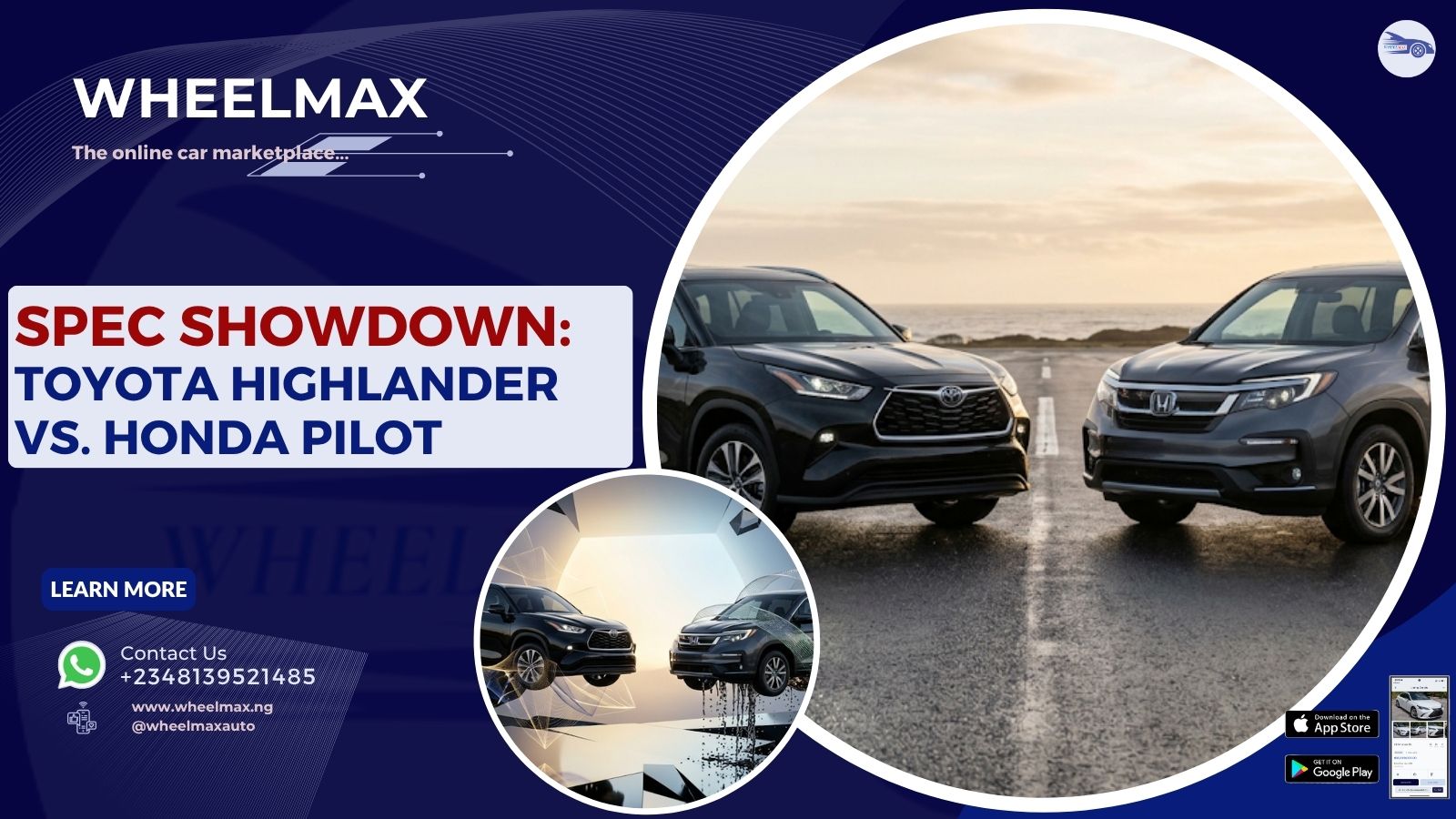
In the Nigerian foreign-used (tokunbo) and certified pre-owned markets, two Japanese heavyweight nameplates dominate family car discussions: the Toyota Highlander and the Honda Pilot.
Both vehicles are engineered primarily for the North American market, offer robust V6 powerplants, and seat up to eight passengers. However, beneath their shared mission lies two fundamentally different engineering philosophies.
Does the Toyota Highlander’s legendary resale value and mechanical simplicity justify its premium price tag? Or does the Honda Pilot’s superior interior space and value-for-money make it the smarter buy for your family?
In this edition of Wheelmax Spec Showdown, we place these two titans head-to-head across space, V6 power, reliability, and real-world running costs on Nigerian roads.
1. Space & Practicality: The Family Utility Test
When buying a three-row crossover in Nigeria, third-row usability and cargo capacity are paramount. Between school runs, church trips with extended family, and holiday interstate travel with heavy luggage, cabin packaging matters.
Honda Pilot: The Space Champion
1. Seating Capacity: 8 passengers (standard on most trims)
2. Third-Row Usability: Excellent. The Pilot’s boxy, upright roofline and minivan-inspired chassis deliver legitimate head- and legroom in the third row. Full-grown teenagers and average-height adults can sit back there for long journeys without feeling cramped.
3. Cargo Room Behind Row 3: Generous. Even with all three rows occupied, the Pilot provides a deep rear trunk well capable of accommodating grocery bags, suitcases, or small storage bins.
4. Cabin Storage: Packed with family-friendly features: multiple deep dashboard shelves, a multi-tiered center console that can swallow large handbags, and built-in rear window sunshades on higher trims.
Toyota Highlander: The Cozy Cruiser
1. Seating Capacity: 7 or 8 passengers (depending on whether the second row features captain's chairs or a 60/40 bench)
2. Third-Row Usability: Cramped. The Highlander’s sleek, tapered roofline and elevated floor mean its third row is notoriously tight. The seat cushion is thin, sits flat on the floor, and offers minimal legroom. It is strictly a "penalty box" reserved for young children or emergency short trips.
3. Cargo Room Behind Row 3: Limited. With the third row deployed, the remaining luggage space is shallow. Accommodating luggage for an interstate trip to the village will almost certainly require folding down the third row.
4. Cabin Storage: Highly functional. The standout feature is a full-width integrated dashboard shelf equipped with cable pass-throughs, ideal for resting smartphones and toll tickets.
Round 1 Verdict: Honda Pilot wins. If you routinely transport six or more full-sized passengers, the Pilot is significantly more spacious and practical. The Highlander is effectively a "5+2" crossover.
2. V6 Powertrains & Driving Dynamics
Both contenders feature naturally aspirated 3.5-liter V6 engines that generate ample power for highway overtaking and heavy passenger loads. However, their internal mechanics differ significantly.
Toyota Highlander: 3.5-Liter 2GR V6 Powertrain
1. Engine Architecture: 3.5L naturally aspirated DOHC V6 (2GR-FE producing ~270 hp; upgraded to 2GR-FKS direct/port-injected producing ~295 hp on 2017+ models)
2. Transmission: 6-Speed Automatic (2008–2016) or 8-Speed Automatic (2017+)
3. Timing Mechanism: Internal heavy-duty steel timing chain
4. The Driving Experience: The Highlander feels composed, car-like, and smooth. Throttle delivery is linear, the 6-speed automatic shifts predictably, and the cabin remains remarkably quiet at 100 km/h.
5. The Big Advantage: Because it uses an internal timing chain rather than a rubber belt, there is no mandatory scheduled replacement interval. It is designed to last the life of the engine if oil changes are maintained.
Honda Pilot: 3.5-Liter J35 V6 Powertrain
1. Engine Architecture: 3.5L naturally aspirated SOHC V6 (J35 series producing 250 hp to 280 hp depending on the generation)
2. Transmission: 5-Speed or 6-Speed Automatic, or ZF 9-Speed Automatic (Touring/Elite trims)
3. Timing Mechanism: External rubber timing belt
4. The Driving Experience: The Pilot offers punchy, aggressive low-end torque. The engine note is throaty when pushed, and the steering is light, making this large SUV easy to maneuver through tight neighborhood streets.
5. The Big Caveat: The J35 engine uses a rubber timing belt that must be replaced every 100,000 kilometers. If this belt snaps while driving, the pistons will smash into the valves, resulting in catastrophic engine failure.
Round 2 Verdict: Toyota Highlander wins. While the Pilot offers spirited low-end acceleration, the Highlander’s timing chain, bulletproof 2GR V6 architecture, and smoother transmission deliver greater long-term peace of mind.
3. Reliability & Nigerian Road Durability
Nigerian operating conditions—deep potholes, intense tropical heat, and variable fuel quality—test mechanical resilience to the extreme. Here is how each vehicle handles the local environment:
Toyota Highlander: Known Nigerian Road Realities
1. Suspension: Front lower control arm bushings and stabilizer bar drop links are standard wear items over potholed roads, but they are inexpensive and easy to replace.
2. Water Pump Weep: The 2GR-FE engine's water pump typically develops a slow pink crust/coolant weep around 130,000 to 160,000 km. It requires proactive replacement to avoid overheating.
3. Steering Shaft Clunk: Like the Venza, older Highlanders can develop a dull rattle in the intermediate steering column over washboard roads, which requires regreasing or shaft replacement.
4. 8-Speed Hesitation (2017+ Models): Early 8-speed automatic gearboxes can exhibit minor gear-hunting or delayed downshifts in dense traffic, requiring a dealership software update.
Honda Pilot: Known Nigerian Road Realities
1. Variable Cylinder Management (VCM) Issues: To save fuel, the Pilot's engine computer shuts down cylinders during light cruising. In Nigeria’s stop-and-go traffic, this system causes excessive engine vibration, premature collapse of expensive active hydraulic motor mounts, and oil consumption that fouls spark plugs.
The Fix: Most Nigerian owners install an aftermarket "VCM Muzzler/Disabler" to keep all six cylinders firing permanently.
2. Rubber Timing Belt Service: Sourcing genuine Honda timing belt kits and tensioners in Nigeria requires extreme care, as counterfeit timing belts will snap prematurely.
3. Transmission Fluid Sensitivity: Honda automatic gearboxes and CVTs are intolerant of generic fluids. Using anything other than genuine Honda ATF DW-1 (or Honda 3.1 fluid for 9-speed units) causes harsh shifting, shuddering, and clutch pack burnout.
4. Rear Differential Fluid (AWD Models): The Dual-Pump or i-VTM4 rear differential requires fresh fluid every 30,000 km to prevent shuddering during low-speed turns.
Round 3 Verdict: Toyota Highlander wins. The Highlander handles deferred maintenance, irregular fuel, and rough roads with greater forgiveness. The Pilot is mechanically sound, but its timing belt, VCM system, and transmission require strict, disciplined oversight.
4. Running Costs & Ownership Economics
The purchase price is only the beginning of your financial relationship with a vehicle. Let's examine what ownership looks like on a day-to-day basis in Nigeria.
Fuel Consumption in Nigerian Driving Conditions
Toyota Highlander (3.5L V6):
City (Lagos/Abuja Gridlock): 13.0 – 16.0 Liters / 100 km (roughly 6.2 – 7.7 km per Liter)
Highway (Clear Interstate): 9.0 – 10.5 Liters / 100 km (roughly 9.5 – 11.1 km per Liter)
Honda Pilot (3.5L V6):
City (Lagos/Abuja Gridlock): 14.0 – 17.5 Liters / 100 km (roughly 5.7 – 7.1 km per Liter)
Highway (Clear Interstate): 9.5 – 11.0 Liters / 100 km (roughly 9.1 – 10.5 km per Liter)
Verdict: Both vehicles have similar fuel appetites. The Highlander holds a slight edge in dense city traffic, particularly on models with newer multi-speed transmissions.
Spare Parts Availability & Mechanic Familiarity
1. Toyota Highlander: Because the Highlander shares engine, brake, and chassis parts with the Toyota Camry, Avalon, Venza, and Lexus RX 350, parts availability is unmatched. Any mechanic from Ladipo in Lagos to Apo in Abuja can diagnose and repair a Highlander with their eyes closed. Parts are stocked on almost every shelf.
2. Honda Pilot: Genuine Honda parts are widely available in major automotive markets, but specialist knowledge is required. You cannot hand a modern Pilot over to an untrained roadside mechanic who does not understand VCM systems or Honda-specific diagnostic procedures.
Initial Purchase Price vs. Resale Value (The "Toyota Tax")
1. The Purchase Reality: In Nigeria, the Toyota Highlander commands a steep "Toyota Tax." On the pre-owned market, a comparable-year, equivalent-condition Highlander typically costs 20% to 35% more than a Honda Pilot.
2. The Resale Reality: That same premium protects your money on the other side. When it is time to sell, the Highlander depreciates at a significantly slower rate and can be converted back to cash within days.
Direct Spec-Check Breakdown
Toyota Highlander
1. Best For: Families wanting stress-free ownership, rock-solid resale value, and bulletproof mechanical endurance.
2. Strengths: Timing chain durability, silky 2GR V6 engine, universal parts availability, unmatched resale liquidity.
3. Weaknesses: Cramped third-row legroom, smaller cargo hold behind row 3, significantly higher acquisition cost.
Honda Pilot
1. Best For: Practical families with older children or extended relatives who need genuine 8-passenger capacity and maximum interior space for less initial money.
2. Strengths: True adult-sized third row, expansive cargo area, lower purchase price, comfortable ride quality.
3. Weaknesses: Timing belt replacement expense, VCM-related engine mount wear, strict transmission fluid requirements, steeper depreciation.
The Wheelmax Final Verdict: Which One Should You Buy?
Both the Toyota Highlander and the Honda Pilot are exceptional family crossovers, but they cater to two distinct buyer priorities:
Buy the Honda Pilot If:
Your top priority is interior space and value-for-money. If you have teenage children, frequently travel with extended family, or need to haul luggage and six passengers simultaneously, the Pilot’s cabin architecture is vastly superior. Furthermore, because you avoid the inflated "Toyota Tax," your purchase budget buys you a newer, lower-mileage, better-equipped vehicle with features like rear-seat entertainment and panoramic roofs. As long as you proactively manage the timing belt and disable the VCM, the Pilot is a phenomenal family workhorse.
Buy the Toyota Highlander If:
Your top priority is long-term reliability, low-stress maintenance, and resale protection. If your third row will primarily be used by younger children, the tighter rear quarters will not bother you. In exchange, you get the bulletproof peace of mind of Toyota's chain-driven 3.5L V6, universal parts availability across all 36 states, and a vehicle that will retain its monetary value better than almost anything else in its segment.
Found your ideal family SUV? Protect your investment from hidden flood damage, chassis repairs, and rolled-back mileage. Book a comprehensive computerized Pre-Purchase Inspection (PPI) with the certified automotive specialists at Wheelmax today.