
If you have ever spent time looking at car listings on Wheelmax, you have encountered two numbers that seem to define a car’s "personality": Horsepower (hp) and Torque (lb-ft or Nm).
In the Nigerian automotive market, these terms are often used by sellers to justify a high price tag. But for the person behind the wheel, these aren't just abstract numbers. They determine if you can safely overtake a truck on the Lagos-Ibadan Expressway, how comfortably you can climb a steep bridge with five passengers, and how much you’ll spend on fuel.
At Wheelmax, we believe in moving you from "guessing" to "knowing." This deep dive will demystify the science of power so you can choose the engine that actually fits your life.
1. The Simplest Comparison: Strength vs. Speed
To understand the difference, let’s leave the engine bay for a moment and look at two different types of athletes.
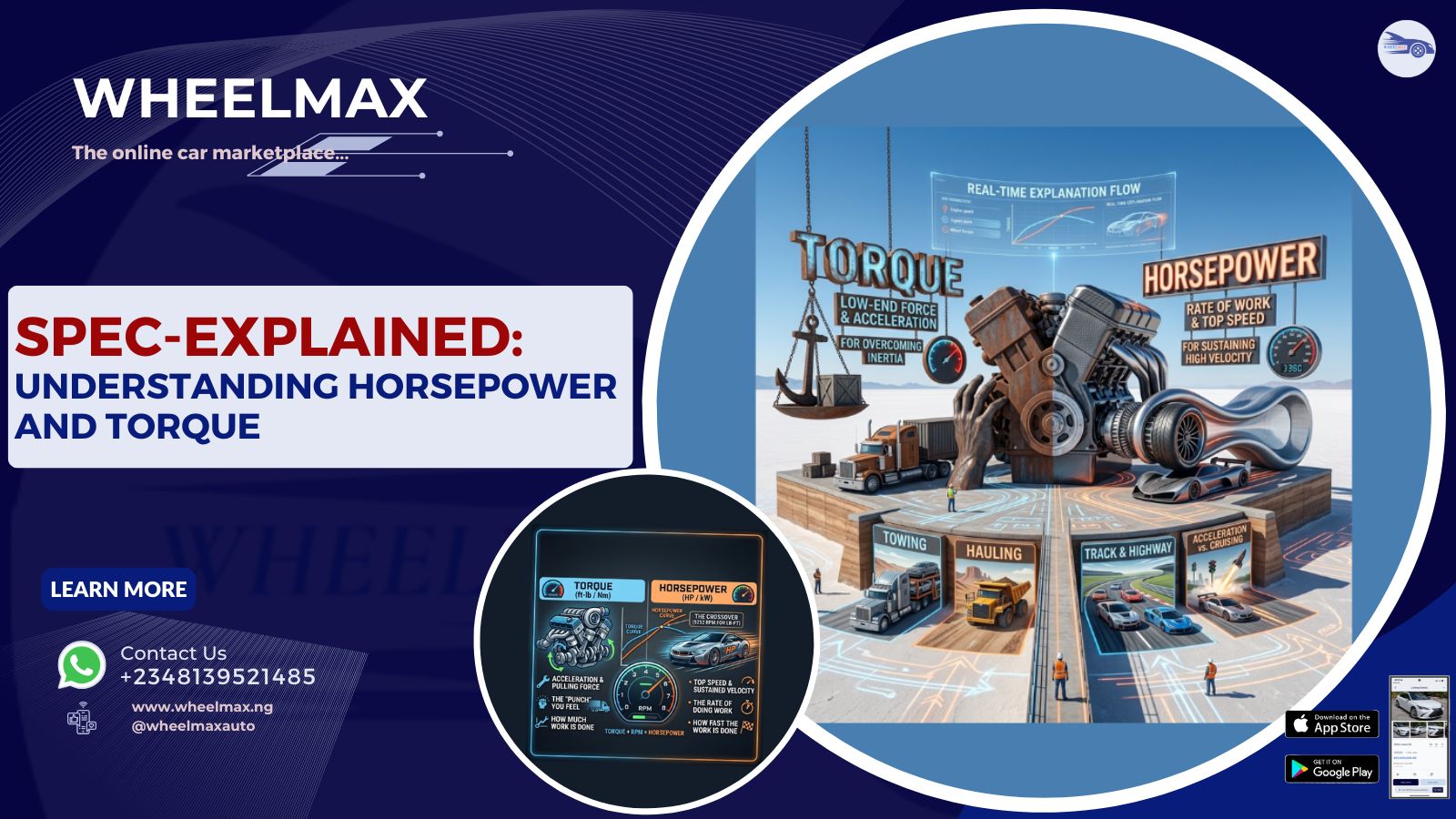
a. Torque is a Weightlifter: Imagine a strongman lifting a 200kg barbell. He has the raw strength (twisting force) to move a massive weight from a standstill. He doesn't move fast, but he is incredibly powerful. Torque is "Strength."
b. Horsepower is a Sprinter: Imagine Tobi Amusan or Usain Bolt. They might not be able to lift a 200kg barbell, but they can move their weight across a distance very quickly. Horsepower is "Speed."
The Golden Rule: Torque does the heavy lifting to get the car moving; Horsepower determines how fast you can keep that car going.
2. Deep Dive: What is Torque? (The "Oomph")
Technically, torque is a measurement of twisting force. In your engine, when the fuel ignites, it pushes a piston down, which turns the crankshaft. That "turning" or "twisting" effort is torque.
Why Torque Matters in Nigeria:
a. The "Lagos Traffic" Factor: In start-and-stop traffic, you need torque to get a heavy vehicle moving from zero to 20km/h repeatedly. High-torque cars feel "light" and responsive in traffic.
b. Towing and Heavy Loads: If you are buying a Toyota Hilux for a construction site or a Lexus LX 570 for family trips, torque is what allows you to carry that heavy load without the engine sounding like it’s struggling.
c. Climbing: Whether it’s a steep ramp in a multi-story car park or a hilly road in Ekiti, torque is the force that "pulls" you up.
If a car has low torque but high horsepower, it will feel "sluggish" or "dead" when you first step on the gas.
3. Deep Dive: What is Horsepower? (The "Go")
Horsepower is a calculation of how much "work" is done over a specific period. If torque is the ability to turn the wheels, horsepower is the rate at which you can keep them turning.
Why Horsepower Matters in Nigeria:
a. Highway Overtaking: When you are already doing 80km/h and you need to pass a slow-moving trailer, horsepower is what gives you that second surge of energy to reach 100km/h or 120km/h quickly.
b. Top Speed: Horsepower determines how fast a car can ultimately go.
c. Stamina: High horsepower allows a car to maintain high speeds for long periods (like a trip from Lagos to Abuja) without the engine overheating or straining.
4. The "Missing Link": Understanding RPM
You’ll often see specs written like this: 270 hp @ 6,000 RPM.
RPM (Revolutions Per Minute) is how fast the engine is spinning.
1. Low-end Torque: Some cars (like Diesels or Turbos) give you all their strength at low RPMs (e.g., 1,500 RPM). This means the car feels powerful the moment you touch the pedal.
2. High-end Horsepower: Most petrol cars need to "rev" high to reach their maximum horsepower. This is why your engine "screams" when you try to speed up suddenly—it is searching for that horsepower at the top of the RPM range.
5. Frequently Asked Questions (The "Reality Check")
"Which is better for fuel economy?"
Generally, an engine with high torque at low RPMs is more fuel-efficient in the city. Why? Because the engine doesn't have to work hard (rev high) to get the car moving. This is why modern Turbocharged 4-cylinders (like in the newer Honda Accords) are replacing big V6s they offer "big torque" early on, saving fuel.
"Why does my car feel weak even though the paper says it has high Horsepower?"
This usually happens in small, non-turbo engines (like an older Toyota Corolla). It might have decent horsepower for the highway, but it has very low torque. When you have four passengers and the A/C is on full blast, the car feels "heavy" because it lacks the raw torque to move that weight.
"What about Electric Vehicles (EVs)?"
This is the 2026 game-changer. EVs have Instant Torque. Unlike a petrol car that has to build up speed, an EV gives you 100% of its strength the millisecond you touch the pedal. This is why even a "basic" electric car can out-accelerate a powerful petrol sports car in a city environment.
"Does the transmission matter?"
Yes! The gearbox acts as a Torque Multiplier. Low gears (1st and 2nd) are designed to maximize torque to get you moving. High gears (5th and 6th) are designed to maximize horsepower and fuel efficiency once you are already cruising.
6. The Wheelmax Buying Strategy: Which should you choose?
The Bottom Line
At Wheelmax, we don't want you to just buy a car with "big numbers." We want you to buy a car with the right numbers.
If you are a city driver, stop chasing Horsepower and start looking for Torque. If you are a highway king, ensure you have the Horsepower to back up your journey.
Still have questions about a specific car's performance? Chat with a Wheelmax consultant today. We’ll help you find the "muscle" or the "speed" you need for the Nigerian road.