
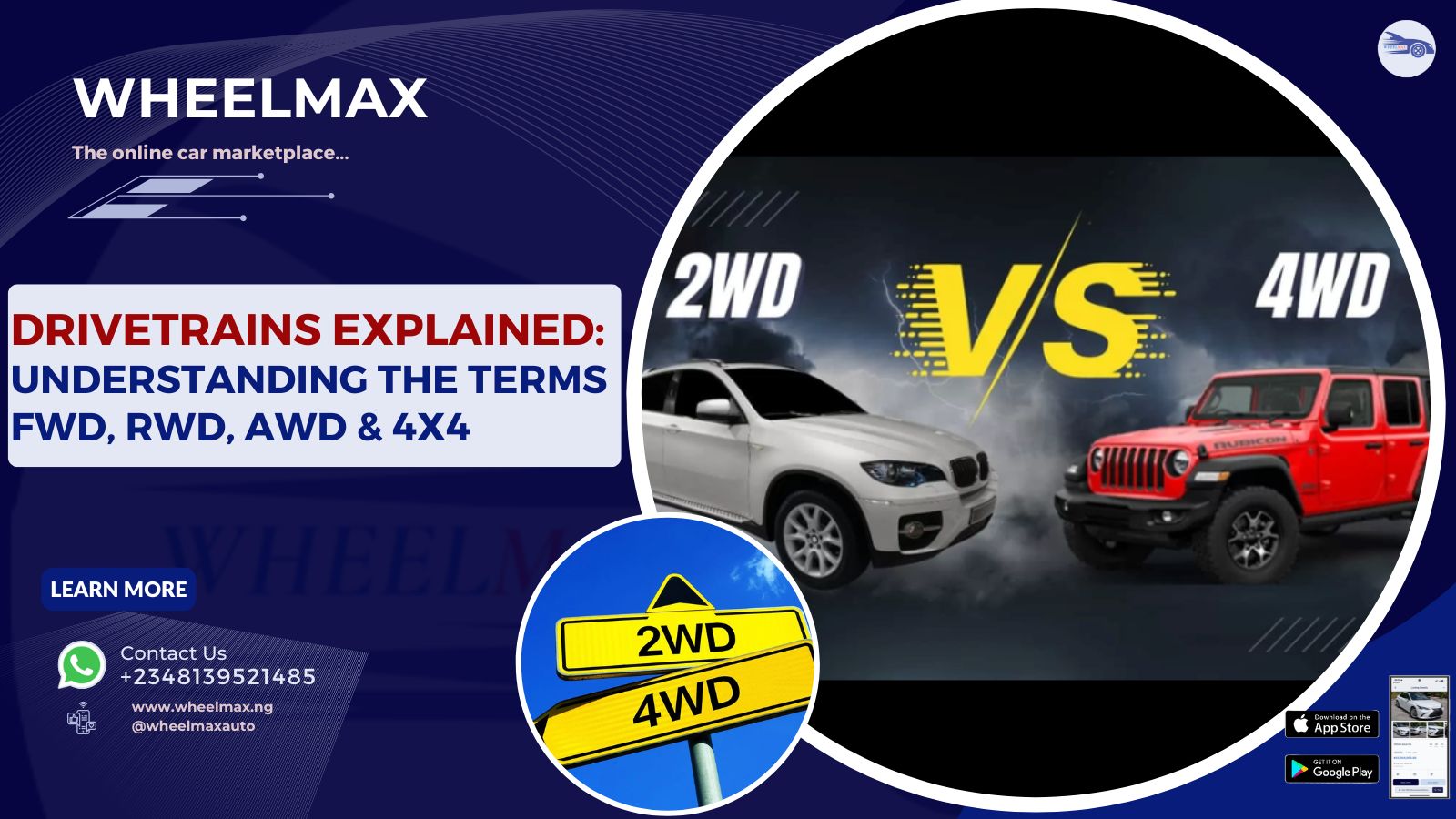
You're comparing two SUVs. They look identical, have the same engine, but one is labeled "AWD," and another, a rugged-looking truck, is labeled "4x4." You know these letters are important, but you're left with a cloud of high-stakes questions. What do they really mean? Is AWD the same as 4x4? Is one better for our rainy seasons, or are they expensive, fuel-guzzling gimmicks?
This confusion can lead to either overspending on a capability you don't need or, worse, underspending and finding yourself with a vehicle that gets stuck when you need it most.
In this definitive Spec-Explained, we are demystifying the world of drivetrains. We will break down Front-Wheel Drive (FWD), Rear-Wheel Drive (RWD), All-Wheel Drive (AWD), and Four-Wheel Drive (4WD/4x4) in simple terms. By the end, you will understand the deep engineering principles, the real-world differences, and the crucial financial implications, empowering you to choose the perfect spec for your Nigerian driving life.
The Fundamental Concept: Where Does the Power Go?
A car's drivetrain is the system that delivers power from the engine to the wheels. The key difference between these systems is which wheels receive power and how that power is managed.
1. FWD (Front-Wheel Drive): The Sensible Standard
What It Is: The engine's power is sent exclusively to the front wheels, which both steer and pull the car forward.
The Pros: Superior fuel economy, lower purchase and maintenance costs, and good traction in most conditions because the engine's weight is over the drive wheels. It also allows for more interior space.
The Cons: Not ideal for high-performance handling or heavy towing.
Who Should Buy an FWD Car? For over 90% of Nigerian drivers, FWD is the smartest, most cost-effective choice. If you primarily commute in the city and drive on paved highways, FWD saves you money on fuel and maintenance.
Perfect Examples: Toyota Corolla, Honda Accord, Hyundai Sonata, base model SUVs like the Toyota RAV4 or Kia Sportage.
2. RWD (Rear-Wheel Drive): The Driver's & Workhorse Choice
What It Is: The engine's power is sent exclusively to the rear wheels, which push the car forward.
The Pros: Superior handling balance for performance cars and better traction for towing and carrying heavy loads, which is why it's the standard for pickup trucks.
The Cons: Can be more prone to slipping on very wet or muddy roads compared to FWD. It's also less fuel-efficient and offers less interior space.
Who Should Buy an RWD Car? The driving enthusiast who values performance handling, or anyone buying a pickup truck for its load-carrying advantages.
Perfect Examples: Mercedes-Benz E-Class, BMW 3-Series, Toyota Hilux (in 2WD mode), Ford Ranger (in 2WD mode).
3. AWD (All-Wheel Drive): The "Smart" All-Weather System
What It Is: An automated system where power can be sent to all four wheels. It is designed for on-road performance and safety.
How it Works (The "Automatic" System): Most modern AWD systems are intelligent. They run primarily in FWD (or RWD) mode to save fuel. The car's computer constantly monitors for wheel slip. The instant it detects a slippery surface (like a wet road or a patch of gravel), it automatically and seamlessly engages the other two wheels to provide extra grip. The driver does nothing.
The Pros:
- Maximum On-Road Safety: Provides the best possible grip on tarmac roads during Nigeria's heavy rainy seasons or on oil-slicked surfaces, dramatically reducing the risk of skidding.
- All-Weather Confidence: It's a "set it and forget it" system that gives you peace of mind in almost any on-road condition.
The Cons: Higher purchase price, worse fuel economy, and more complex parts than an FWD system, leading to higher long-term maintenance costs.
Who Should Buy an AWD Car? The safety-conscious driver or family who wants the ultimate confidence on paved roads in all weather conditions and is willing to pay a premium for it.
Perfect Examples: Toyota RAV4 (AWD versions), Lexus RX 350 (AWD versions), Subaru Forester, Range Rover Evoque.
4. 4WD / 4x4 (Four-Wheel Drive): The "Tough" Off-Road System
What It Is: A heavy-duty, driver-selectable system designed for maximum off-road capability. This is not the same as AWD.
How it Works (The "Manual" System): Unlike AWD, 4WD is typically not active all the time. The vehicle runs in RWD mode for normal driving. The driver must manually engage the 4WD system via a button, dial, or lever. 4WD systems often include additional "low-range" gears (4L) which multiply the engine's torque for climbing over rocks or getting out of deep mud.
The Pros:
- Unmatched Off-Road Capability: A true 4x4 system locks the front and rear axles together, forcing all wheels to spin at the same speed. This provides the brute force needed to conquer extreme terrain like deep mud, sand, and steep, rocky inclines where an AWD system would struggle.
- Rugged Durability: 4WD systems are built into rugged, body-on-frame vehicles designed for heavy abuse.
The Cons:
- Not for On-Road Use: Engaging a traditional 4x4 system on dry tarmac can damage the drivetrain. It must be turned off for normal driving.
- Worst Fuel Economy: These are the heaviest and least efficient systems.
Who Should Buy a 4x4? Those who genuinely need to go off-road. This is for people who work on farms or construction sites, live in areas with deeply rutted and muddy roads, or are serious off-road adventure enthusiasts.
Perfect Examples: Toyota Hilux, Ford Ranger, Toyota Land Cruiser Prado, Jeep Wrangler.
The Wheelmax Verdict: Making the Right Choice for YOU
For the Everyday Urban Driver (90% of buyers): Front-Wheel Drive (FWD) is the smartest, most economical choice.
- For the Driving Enthusiast or Heavy-Duty User: Rear-Wheel Drive (RWD) offers unmatched performance handling and is the standard for tough pickup trucks.
- For the Safety-Conscious On-Road Driver: All-Wheel Drive (AWD) is a worthwhile investment for superior traction and peace of mind, especially in the rain.
- For the True Off-Roader or Rural Traveler: Four-Wheel Drive (4x4) is the only choice for conquering Nigeria's toughest terrain.
The drivetrain is a core part of your car's DNA. By understanding the critical difference between the "smart" safety of AWD and the "tough" capability of 4x4, you can choose a car that is truly engineered for your life.
Ready to find a car with the perfect drivetrain? Use the advanced filters on Wheelmax to search for FWD, AWD, or 4x4 models today.