

You've found a car that looks perfect. The pictures are great, the price is in your budget, and you're ready to get excited. Then you click on the "Specifications" tab, and you're hit with a wall of technical jargon and confusing numbers: 1.8L I4, 139 hp, 171 Nm, 160mm ground clearance, 7.8 L/100km...
Suddenly, that excitement turns into anxiety. You know these numbers are the car's DNA, the hard facts that separate a great purchase from a costly mistake, but they might as well be in a foreign language. You’re left to rely on the seller's opinion or, worse, just hope for the best.
This feeling of being out of your depth is the biggest barrier to a confident car purchase.
This guide is designed to permanently eliminate that feeling. We've spent this quarter breaking down individual specs, and now we're putting it all together. This is your definitive Rosetta Stone for car specifications. By the end of this article, you will be able to look at any spec sheet, decode it with ease, and know instantly if a car truly meets your needs for performance, economy, and practicality on Nigerian roads.
Part 1: The Engine & Performance Section - "The Heartbeat"
This section tells you how the car will feel to drive and how much it will cost you in fuel.
- Engine Displacement (e.g., 2.5L 4-Cylinder or 3.5L V6):
- What it is: The total volume of the engine's cylinders. Think of it as the engine's size.
- What it tells you: This is the best quick indicator of power vs. economy. A smaller engine (1.5L - 2.0L) is generally best for city driving and fuel savings. A larger engine (2.5L - 3.5L V6) is better for heavy vehicles and smooth highway power.
- Horsepower (hp):
- What it is: A measure of the engine's total power output.
- What it tells you: This number relates to the car's speed. Higher horsepower means a higher top speed and better performance during high-speed overtaking on an expressway.
- Torque (Nm or lb-ft):
- What it is: A measure of the engine's twisting or "pulling" force.
- What it tells you: This is the power you feel from a standstill. High torque is what pushes you back in your seat and makes a car feel quick in stop-and-go traffic. For a heavy SUV or truck, torque is more important than horsepower for daily driving.
- Drivetrain (FWD, RWD, AWD):
- What it is: Which wheels receive power from the engine.
-
What it tells you:
- FWD (Front-Wheel Drive): Most common, best for fuel economy and predictable handling. The smart choice for most city drivers.
- RWD (Rear-Wheel Drive): The driver's choice, found in sports and luxury cars, offering better handling balance.
- AWD (All-Wheel Drive): The safety choice, providing the best traction on wet, slippery, or unpaved roads. A valuable feature for the Nigerian rainy season.
Part 2: The Efficiency & Cost Section - "The Wallet"
This section tells you how much the car will cost to run.
- Fuel Economy (L/100km):
- What it is: How many litres of fuel the car uses to travel 100 kilometres.
- What it tells you: A lower number is always better. This is a direct indicator of your future fuel bill. Remember to add 20-40% to the official figure for a realistic estimate in Nigerian city traffic.
- Fuel Tank Capacity (Litres):
- What it is: The size of the fuel tank.
- What it tells you: By dividing the tank capacity by the car's L/100km rating (and multiplying by 100), you can estimate the car's total driving range on a full tank.
Part 3: The Dimensions & Practicality Section - "The Body"
This section tells you if the car will physically fit into your life and handle our roads.
- Ground Clearance (mm):
- What it is: The distance from the lowest point of the car to the ground.
-
What it tells you: This is critically important for Nigeria.
- < 160mm: Be very careful on bad roads and with high speed bumps.
- 170mm - 195mm: The sweet spot for most crossovers, offering good confidence.
- > 200mm: Excellent clearance for handling almost any road condition.
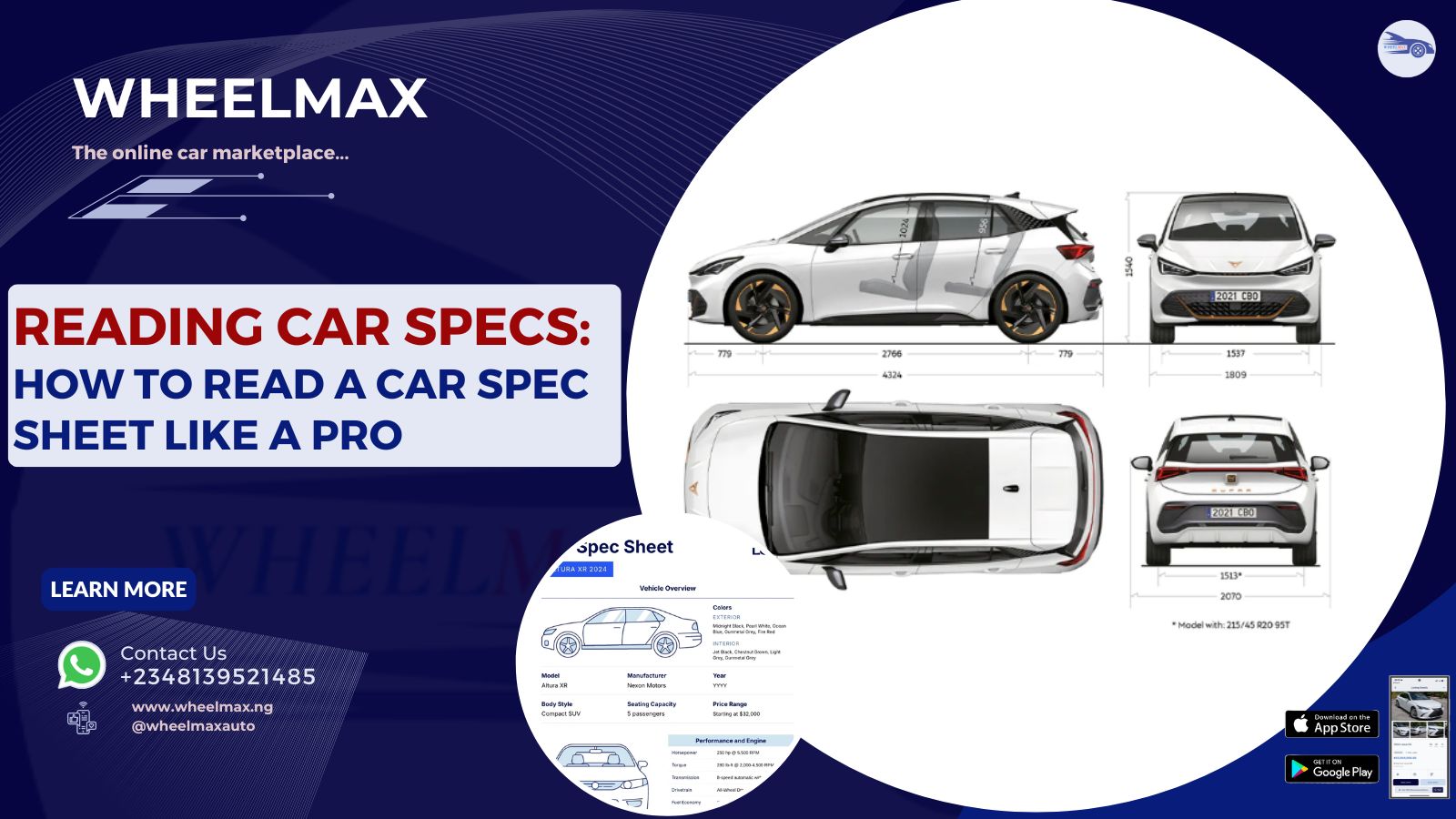
- Length / Width / Height (mm):
- What it is: The car's exterior dimensions.
- What it tells you: Will it fit in your garage or your tight parking spot at the office? A car's width is a key factor for navigating narrow streets.
- Cargo Space / Boot Volume (Litres):
- What it is: The volume of the boot.
- What it tells you: This is a direct measure of practicality. A family sedan might have 400-500L. A large SUV like a RAV4 can have over 1000L. This number tells you if it can handle your family's luggage for a holiday trip.
- Kerb Weight (kg):
- What it is: The weight of the car with all fluids but without passengers or cargo.
- What it tells you: A heavier car will generally use more fuel and wear out its brakes and tyres faster. It also affects how nimble the car feels to drive.
The Wheelmax Verdict: You Are Now the Pro
You no longer have to be intimidated by a spec sheet. By understanding these key terms, you have unlocked the ability to see a car for what it truly is, beyond the shiny paint and the seller's pitch.
You can now confidently compare two cars and know, with data, which one is more powerful, which is more economical, which is more practical for your family, and which is better suited for our unique roads.
This is the power of knowledge. This is how you move from being a hopeful buyer to a confident, empowered owner.