

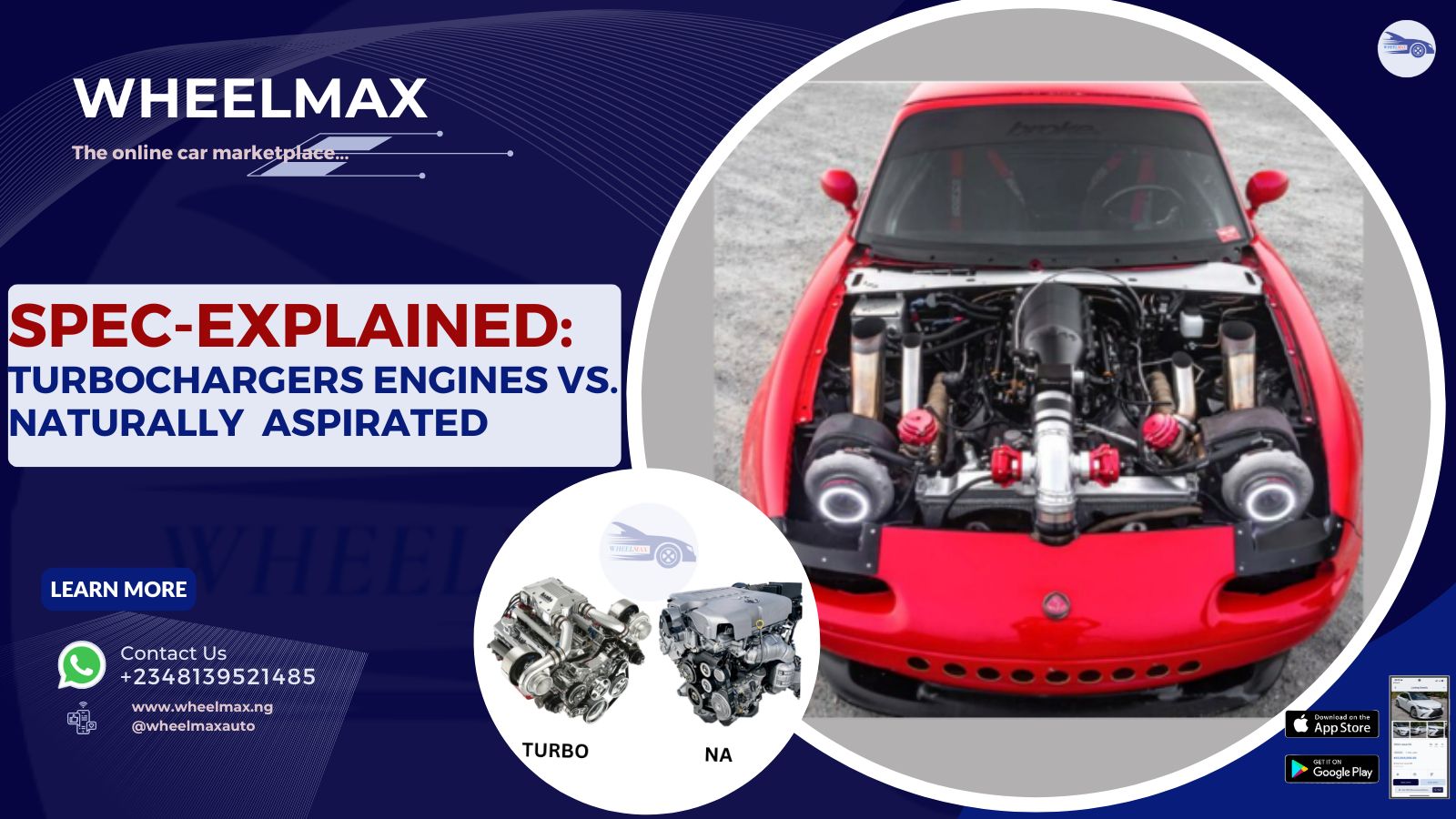
If you’ve been browsing car listings on Wheelmax lately, you might have noticed a significant shift. Smaller engines are taking over. Where a 2010 SUV almost certainly had a "big" V6 engine, its 2024 or 2026 equivalent likely has a small 4-cylinder engine that claims to produce the same power.
This magic is made possible by the Turbocharger. But as a Nigerian driver navigating heavy traffic, high temperatures, and varying fuel quality, is "high-tech" always better than "traditional"?
In this edition of Spec-Explained, we demystify these two engine types to help you decide which one belongs in your garage.
1. Naturally Aspirated (NA): The "Normal" Breather
A Naturally Aspirated engine is the traditional design that has powered cars for over a century. It "breathes" air at normal atmospheric pressure. As the pistons move down, they create a vacuum that sucks air into the combustion chamber.
The Pros: Why Nigerians Love NA Engines
- Legendary Reliability: Because they don't operate under extreme pressure, NA engines tend to have fewer critical points of failure. This is why a 2005 Toyota Corolla is still a staple on our roads today.
- Heat Management: Nigeria is hot. NA engines naturally run cooler than their turbocharged counterparts, putting less strain on your radiator and cooling fans.
- Maintenance Simplicity: Almost every mechanic from Ladipo to Kaduna understands the architecture of an NA engine. Parts are generally cheaper and more widely available.
- Linear Power Delivery: When you press the gas, the power increases smoothly. There are no sudden "surges" or delays.
The Cons:
- Weight vs. Power: To get more power, you need a bigger engine. A bigger engine makes the car heavier, which can negatively impact handling.
- Lower Fuel Efficiency: In city traffic, a 3.5L V6 engine consumes a lot of fuel even when you're just idling, simply because of its size.
2. Turbocharged: The "Efficiency Athlete"
A Turbocharged engine uses a turbine powered by the car’s own exhaust gases to force extra air into the combustion chamber. Think of it as a "forced feeding" system that allows a small engine to punch way above its weight class.
The Pros: The Modern Edge
- Fuel Economy (On Paper): A 2.0L Turbo engine can act like a small, frugal engine when you’re cruising, but turn into a powerful beast when you need to overtake.
- High Torque at Low RPM: Turbos provide "pulling power" very early. This makes the car feel incredibly light and responsive, which is great for quick maneuvers in Lagos traffic.
- Weight Reduction: By using a smaller engine to get the same power, the car is lighter, leading to better braking and more agile steering.
The Cons: The "Nigerian Factor"
- Turbo Lag: There is often a split-second delay (lag) between pressing the pedal and the turbo "spooling up" to provide power.
- Extreme Heat: Turbos operate at incredibly high speeds and temperatures. If your cooling system isn't 100% healthy, a turbo engine will overheat much faster than an NA engine.
- Oil Sensitivity: Turbochargers rely on engine oil for cooling and lubrication. If you use "cheap" mineral oil or skip an oil change, the turbo can seize, leading to a repair bill that could run into millions.
The Deep Dive: How They Compare in Nigeria
Which One Should You Choose?
The Case for Naturally Aspirated (The "Peace of Mind" Choice)
If you are a "buy-and-drive" owner who wants a car that will last 10 years with minimal drama, stick to NA.
- Ideal Models: Toyota Corolla/Camry (Non-Turbo), Lexus ES350/RX350, Honda Accord (older models).
- Best for: Commercial use (Uber/Bolt), frequent interstate travel, or owners who don't want to worry about specific oil grades.
The Case for Turbocharged (The "Modern Performance" Choice)
If you enjoy the latest technology, want better fuel economy on long drives, and don't mind being "best friends" with your mechanic for scheduled maintenance, go Turbo.
- Ideal Models: Mercedes-Benz C300 (W205), Volkswagen Golf/Jetta, Ford Fusion (EcoBoost), newer Honda Accords (1.5T/2.0T).
- Best for: Young professionals, performance enthusiasts, and owners who strictly follow maintenance schedules.
The Wheelmax Bottom Line
In 2026, turbochargers are becoming unavoidable as manufacturers phase out larger engines. However, in Nigeria, a turbocharger is a commitment. It rewards you with a better drive but punishes you if you neglect it. If you choose a turbo, ensure you have access to a diagnostic-capable mechanic and a steady supply of premium synthetic oil.