

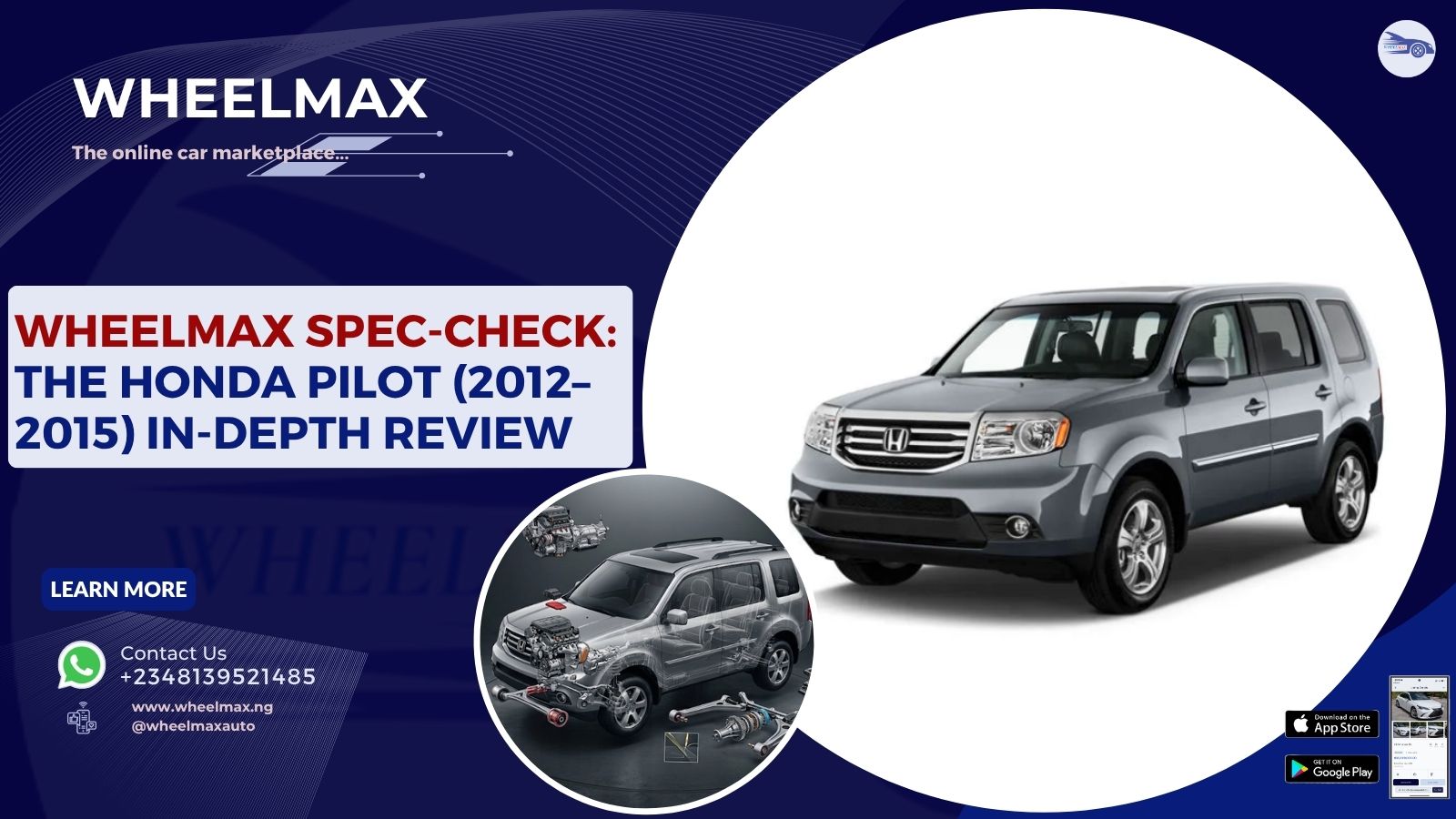
For large Nigerian families, finding a vehicle that comfortably seats more than five people without the cumbersome bulk of a commercial bus or the astronomical price tag of a full-size Lexus LX 570 or Toyota Land Cruiser is a perennial challenge.
Most mid-size crossovers claim to be "seven-seaters," but in reality, their third-row seats are cramped, elevated footwells strictly reserved for small children.
Enter the facelifted second-generation Honda Pilot (2012–2015).
Assembled in Lincoln, Alabama, and designed with the spatial demands of large households in mind, the 2012–2015 Pilot was given a major mid-cycle refresh that replaced the controversial 2009–2011 front fascia with a handsome three-bar chrome grille, upgraded cabin insulation, a modernized dashboard, and improved fuel management.
Today, it stands as one of the most practical, value-dense foreign-used (tokunbo) family SUVs in Nigeria. But does its rugged boxiness translate into long-term mechanical reliability on local roads?
In this comprehensive Wheelmax Spec-Check, we deliver an engineering-backed, real-world assessment of the 2012–2015 Honda Pilot: its 8-seater cabin utility, 3.5L V6 engine dynamics, local maintenance vulnerabilities, and overall ownership economics.
1. Exterior Styling & Stance: The Boxy Advantage
While modern crossovers favor sleek, sloping rooflines that compromise interior space, the second-generation Pilot embraces a rugged, upright silhouette.
Key Dimensions & Exterior Specs:
1. Overall Length: 4,874 mm (191.9 inches)
2. Overall Width: 1,994 mm (78.5 inches)
3. Overall Height: 1,847 mm (72.7 inches)
4. Ground Clearance: 203 mm (8.0 inches)
5. Wheel Options: 17-inch steel/alloy wheels (LX/EX) or 18-inch 6-spoke alloy wheels (EX-L/Touring)
Why Its Shape Matters in Nigeria:
1. Commanding Visibility: The upright windshield, flat hood line, and squared-off rear glass provide unmatched 360-degree outward visibility, making it easy to position this wide SUV through congested traffic and tight market parking lots.
2. Flood and Pothole Clearance: With 8.0 inches of ground clearance and minimal front bumper overhang, the Pilot easily navigates deep water puddles during rainy-season downpours and clears municipal speed bumps without scraping its underside.
3. The 2012 Facelift Upgrades: The 2012–2015 models are easily distinguished from earlier 2009–2011 units by their cleaner, wider chrome grille, restyled front bumper, acoustic-laminated windshield (which significantly reduces road noise), and updated alloy wheel designs.
2. Cabin Practicality & The True 8-Seater Architecture
The primary selling point of the Honda Pilot is its cabin. Unlike rivals that treat the third row as an afterthought, the Pilot was engineered from the ground up to accommodate full-grown passengers in all three rows.
Legitimate 3-Row Adult Seating (2+3+3 Layout)
The second row comfortably accommodates three adults across a 60/40 split-folding bench that can slide forward and backward to optimize legroom. Crucially, the third row also seats three passengers. Because of the boxy roofline, adults up to 5 feet 10 inches can sit in the third row with adequate headroom and their knees positioned naturally, rather than pressed up against their chests.
Tri-Zone Climate Control
In tropical heat, cooling an 8-passenger cabin is essential. EX-L and Touring trims feature a tri-zone automatic climate control system with a dedicated secondary evaporator core and independent fan controls for rear passengers. Air conditioning vents are integrated directly into the B-pillars and third-row ceiling panels, ensuring passengers in the back stay cool in dense traffic.
Cargo Capacity and Hidden Storage
1. Behind the 3rd Row: Even with all eight seats deployed, the Pilot provides 18.0 cubic feet of luggage space, bolstered by a deep under-floor storage well that can conceal laptop bags, tools, or grocery shopping.
2. Rows Folded Flat: Fold down both the second and third rows, and the Pilot transforms into a flat-floored utility cargo van offering 87.0 cubic feet of volume, large enough to carry small generators, building supplies, or flat-pack furniture.
Clever Family Amenities
Higher trims (EX-L and Touring) feature integrated manual sunshades on the rear passenger doors, a factory roof-mounted DVD rear-entertainment system to keep children entertained on long interstate journeys, and a split-opening tailgate glass window that lets you drop items into the trunk without opening the entire heavy liftgate.
3. Powertrain & Driving Dynamics: The 3.5L J35 V6
Under the hood of every 2012–2015 Honda Pilot sits Honda's venerable 3.5-liter naturally aspirated SOHC V6 (J35Z4).
Engine Specifications:
1. Displacement: 3,471 cc (3.5 Liters)
2. Horsepower: 250 hp @ 5,700 RPM
3. Torque: 253 lb-ft (343 Nm) @ 4,800 RPM
4. Valvetrain: 24-Valve SOHC i-VTEC
5. Transmission: 5-Speed Heavy-Duty Electronically Controlled Automatic
6. Drivetrain: Front-Wheel Drive (FWD) or Variable Torque Management 4-Wheel Drive (VTM-4)
Performance & Driving Feel:
Despite weighing over two tons, the Pilot accelerates with surprising authority. The 250-horsepower V6 offers punchy low-end torque, allowing confident highway overtaking along routes like the Lagos–Ibadan Expressway. The steering is light and effortless at low parking speeds, firming up predictably as cruising speed increases.
The VTM-4 4WD System:
Models equipped with Honda’s Variable Torque Management 4-Wheel Drive (VTM-4) operate primarily in front-wheel drive to save fuel, automatically transferring torque to the rear wheels when front-wheel slippage is detected. A dashboard-mounted VTM-4 Lock button allows the driver to manually lock the rear differential at speeds below 30 km/h, providing maximum traction to pull the SUV out of thick sand, wet clay, or muddy unpaved roads.
4. The Nigerian Reality Check: 5 Known Vulnerabilities
While the Pilot is robustly built, operating in Nigeria’s climate of extreme heat, severe stop-and-go idling, and irregular roads exposes specific mechanical failure points. Every buyer must understand these five areas:
1. Variable Cylinder Management (VCM) Issues
1. The Problem: The J35Z4 engine features Honda's VCM system, which automatically deactivates 2 or 3 cylinders during cruising to conserve fuel. In Nigerian driving conditions—where vehicles alternate constantly between creeping traffic and sudden acceleration—the constant cylinder deactivation creates severe engine vibrations.
2. The Consequence: Over time, VCM causes oil to bypass the unsealed piston rings of the deactivated cylinders, leading to excessive engine oil consumption, fouled spark plugs (triggering P0301–P0304 misfire codes), and premature failure of the vehicle's expensive active hydraulic engine mounts.
3. The Permanent Fix: Experienced Nigerian owners install an inexpensive aftermarket "VCM Muzzler" or "VCM Tuner" resistor unit. This device safely disables cylinder shutdown, keeping the engine operating on all six cylinders permanently, eliminating vibration, and protecting spark plugs.
2. The Rubber Timing Belt (Interference Engine)
1. The Problem: Unlike Toyota's V6 engines which use internal steel timing chains, the Honda 3.5L V6 uses an external rubber timing belt.
2. The Risk: This is an "interference" engine. If the rubber timing belt snaps while driving, the valves will collide with the pistons, instantly destroying the cylinder heads and requiring a complete engine replacement.
3. The Maintenance Rule: The timing belt, hydraulic tensioner, idler pulleys, and water pump must be replaced every 100,000 kilometers. Never buy a tokunbo Pilot without verifying the timing belt history, and never use cheap counterfeit replacement belt kits.
3. Front Lower Control Arm Compliance Bushings
1. The Problem: The Pilot’s curb weight (over 2,050 kg) puts enormous physical strain on its front suspension assembly when negotiating deep potholes and speed bumps.
2. The Symptoms: A distinct, dull thud or clunking sound over sharp road ripples, accompanied by slight steering instability during high-speed highway braking.
3. The Fix: The large, fluid-filled front lower control arm "compliance" rubber bushings tear every 40,000 to 60,000 km on Nigerian roads. Replace them with high-quality OEM or solid rubber aftermarket bushings.
4. Transmission Fluid Sensitivity (ATF DW-1 Only)
1. The Problem: Honda’s 5-speed automatic transmission relies on specific friction-modifying additives to operate smoothly.
2. The Risk: Roadside mechanics frequently top off or replace transmission fluid with generic multi-vehicle fluids or red Dexron oil. This leads to torque converter shudder, harsh gear engagement, and burned clutch packs.
3. The Fix: Demand that your technician use only genuine Honda Genuine ATF DW-1. Perform a drain-and-fill service every 35,000 to 40,000 km.
5. Rear Differential Fluid Breakdown (VTM-4 Models)
1. The Problem: On AWD variants, the rear differential utilizes a dual-clutch pack system that generates heat in heavy traffic.
2. The Symptoms: A low groaning, moaning, or juddering noise from the rear axle during slow, sharp turns (such as maneuvering into a parking bay).
3. The Fix: Drain and refill the rear differential exclusively with Honda VTM-4 Differential Fluid every 30,000 km. Never use standard GL-5 gear oil in the VTM-4 unit.
5. Ownership Economics: Fuel, Maintenance & Market Value
Understanding the day-to-day costs of running a large V6 SUV in Nigeria ensures you budget realistically:
Fuel Consumption in Nigerian Driving Conditions
1. City Driving (Dense Lagos/Abuja Traffic): 14.5 – 17.5 Liters / 100 km (roughly 5.7 – 6.9 km per Liter).
2. Highway Cruising (Clear Interstate @ 100 km/h): 9.5 – 11.0 Liters / 100 km (roughly 9.1 – 10.5 km per Liter).
3. Note: Disabling the VCM system increases city fuel consumption by roughly 5–7%, but saves you hundreds of thousands of Naira in engine mount and spark plug replacements over time.
Routine Servicing Costs (Every 6,000 – 7,500 km)
1. Oil Capacity: 4.3 Liters (with filter change).
2. Recommended Viscosity: High-grade 0W-20 or 5W-20 Full Synthetic Oil (never use thick SAE 40/50 commercial oil).
3. Service Budget: Budget N45,000 to N70,000 for routine synthetic oil, genuine Honda oil filter, and air filter maintenance.
Parts Availability & Pricing Advantage vs. Toyota Highlander
1. The Acquisition Advantage: On the Nigerian pre-owned market, a 2012–2015 Honda Pilot typically sells for 20% to 30% less than a comparable-year Toyota Highlander. This means you get a newer vehicle with true 8-seater capacity and leather interior for significantly less upfront capital.
2. Parts Support: Mechanical consumables (brake pads, filters, ball joints, radiators) are widely stocked across major auto hubs like Ladipo, Trade Fair, and Apo. However, major electronic sensors and genuine timing belt kits should only be sourced through verified Honda parts specialists.
6. The Wheelmax Buyer's Pre-Purchase Checklist
Before committing funds to a foreign-used (tokunbo) 2012–2015 Honda Pilot, execute these essential inspections:
1. Inspect the Front Spool Valve for Oil Leaks: Check the top passenger side of the engine block near the alternator. The variable valve timing (spool valve) gasket frequently leaks engine oil directly onto the alternator, which eventually shorts out the charging system.
2. Perform the Cold-Start Engine Mount Test: Pop the hood, apply the foot brake, put the vehicle in Drive, and gently tap the accelerator. Excessive engine rocking indicates that the front or rear active hydraulic motor mounts are torn.
3. Check the Oil Dipstick and Spark Plugs: Pull the dipstick to check for sludged or low oil. If possible, have a technician inspect spark plugs on cylinders 1, 2, and 3 for heavy black oil fouling caused by VCM blow-by.
4. Listen for Transmission Shudder: During your test drive, gently accelerate from 35 km/h to 65 km/h in top gear. Any subtle shuddering or vibrating sensation indicates degraded transmission fluid or torque converter wear.
5. Verify US Title History via Carfax / AutoCheck: The Pilot is an American-market vehicle. Check the 17-digit VIN to confirm the car does not carry a Salvage, Rebuilt, or Flood title from US hurricane zones, and confirm the odometer reading has not been altered.
The Wheelmax Verdict
The 2012–2015 Honda Pilot is not built for sports-car handling or sleek curbside posturing. It is an honest, brilliantly packaged family utility vehicle designed to solve the real logistical challenges of a large household.
While it requires more technical maintenance discipline than a comparable Toyota, specifically regarding its rubber timing belt, specialized transmission fluids, and VCM management, it rewards its owner with true eight-passenger capability, an ultra-quiet cabin, expansive cargo space, and exceptional value per Naira.
For Nigerian families seeking dependable three-row versatility on a sensible budget, a properly vetted 2012–2015 Honda Pilot remains one of the smartest, most practical SUV investments on the market.
Planning to buy a foreign-used Honda Pilot? Ensure you don't inherit hidden VCM damage, worn timing belts, or flood issues. Book a computerized Pre-Purchase Inspection with the certified automotive specialists at Wheelmax today.