
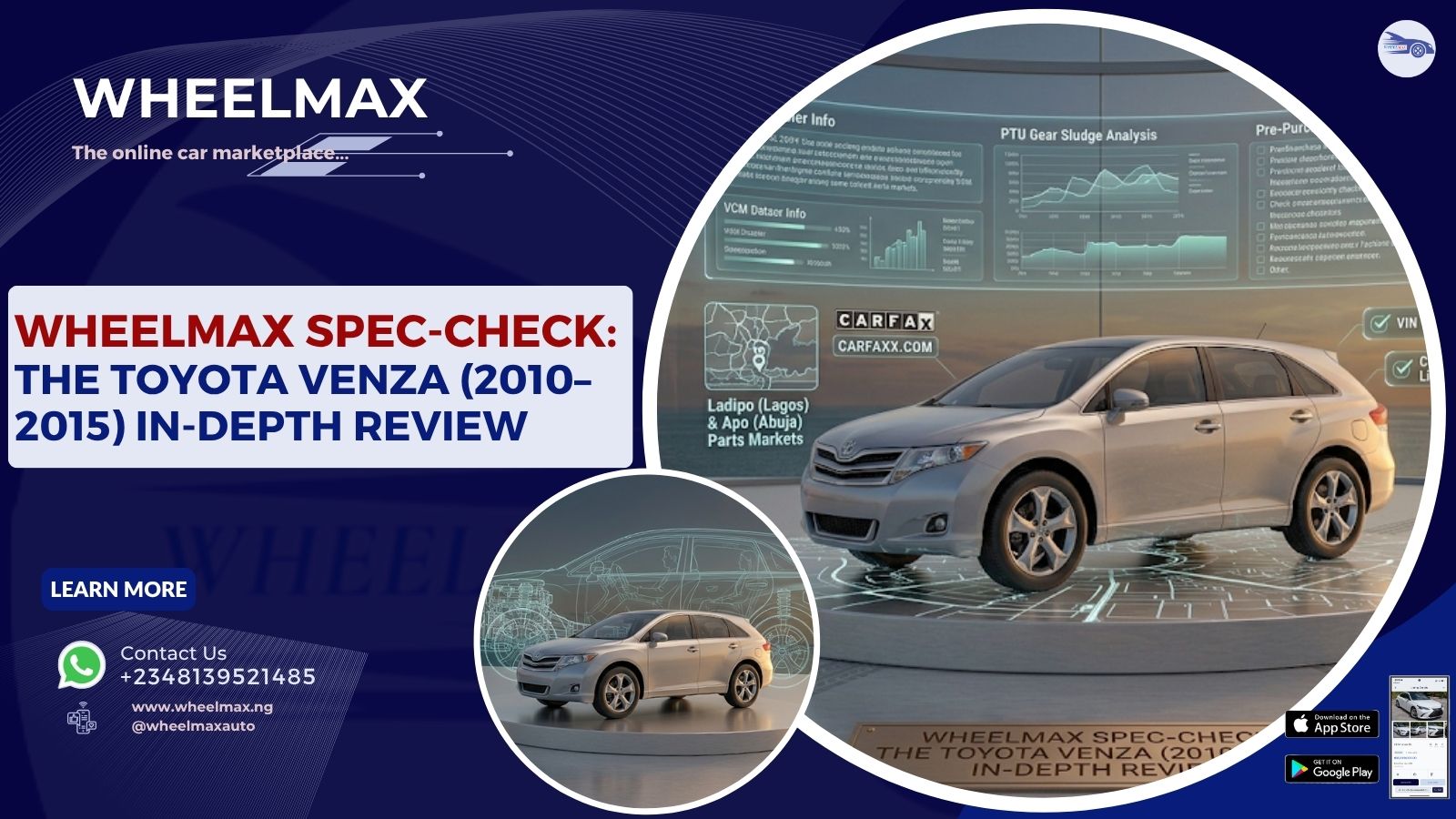
In the history of the Nigerian automotive market, few vehicles have captured the public imagination quite like the first-generation Toyota Venza.
Introduced for the 2009 model year and manufactured exclusively at Toyota’s Georgetown, Kentucky assembly plant in the United States, the Venza was designed specifically for North American buyers who wanted something sleeker than a boxy minivan and more practical than an executive sedan.
When it arrived on Nigerian shores as foreign-used (tokunbo) imports, it sparked a cultural movement. From the commercial nerve centers of Lagos to the leafy diplomatic districts of Abuja, the Venza quickly became the unofficial uniform of upwardly mobile professionals, tech entrepreneurs, and modern families.
Over a decade after its production run, the 2010 - 2015 Toyota Venza remains one of the most liquid, sought-after, and fiercely debated vehicles in the country.
In this comprehensive Wheelmax Spec-Check, we provide the definitive Nigerian buyer's guide to the 2010–2015 Toyota Venza: dissecting its bulletproof V6 powertrain, lounge-like cabin, common road-induced failure points, and real-world ownership economics.
1. Exterior Design & Road Presence: The High-Riding Silhouette
The genius of the Toyota Venza lies in its visual architecture. Built on a modified Toyota K-platform (sharing structural DNA with the XV40 Camry and the second-generation Highlander), the Venza defies conventional classification. It is neither a traditional station wagon nor a typical boxy SUV.
Key Dimensions & Exterior Specs:
1. Overall Length: 4,801 mm (189.0 inches)
2. Overall Width: 1,905 mm (75.0 inches)
3. Ground Clearance: 205 mm (8.1 inches)
4. Standard Wheel Sizes: 19-inch alloys (4-Cylinder models) or massive 20-inch alloys (V6 models)
Why Its Styling Works for Nigeria:
1. The Ground Clearance Advantage: With 8.1 inches of ground clearance, the Venza sits just as high off the ground as many dedicated mid-size SUVs (including the Lexus RX 350). It glides effortlessly over high municipal speed bumps, uneven gutters, and rain-season flash floods that would scrape the undercarriage of a standard Toyota Camry or Corolla.
2. The 2013 Facelift Refresh: In 2013, Toyota granted the Venza a mid-cycle refresh that gave it a more aggressive front fascia, a redesigned chrome bar grille, restyled fog lamp housings, integrated puddle lamps in the side mirrors, and updated LED daytime running light accents. The 2013–2015 models command a noticeable price premium in Nigeria due to these modern aesthetic tweaks.
2. Interior Space & Comfort: The "Limousine Crossover"
Step inside the Venza, and its American-market heritage becomes immediately apparent. The cabin was engineered around width and horizontal volume rather than third-row density.
Unrivaled Shoulder and Leg Room
Because Toyota chose not to cram a cramped third row into the back, the second-row passengers enjoy executive-level legroom. Three full-grown adults can sit across the rear bench in total comfort, aided by a completely flat rear floor pan that eliminates the intrusive center transmission tunnel found in most crossovers. Furthermore, the rear seatbacks recline up to 14 degrees for long-distance highway travel.
The Iconic 60/60 Center Console
The front cabin features what Toyota termed "60/60 seating architecture," designed to give both the driver and front passenger the feeling that 60% of the interior space belongs to them. The center console is cavernous: it houses illuminated sliding cup holders, dedicated concealed compartments for smartphones with integrated cable pass-through channels, and a deep armrest bin capable of swallowing large handbags or small laptops.
The Panoramic Dual-Pane Roof
Higher-spec trims (XLE and Limited) feature a dual-pane panoramic glass sunroof. The front pane tilts and slides open, while the rear fixed glass roof bathes the rear passenger quarters in natural ambient light.
Wheelmax Ownership Note: The panoramic roof is fitted with dual motorized fabric sunshades. In Nigeria’s intense afternoon heat, prolonged exposure can bake the plastic guide clips and dry out the electric drive cables. Ensure the sunshade tracks are lubricated and clean; a jammed shade can cost between N60,000 and N120,000 in specialized interior labor to repair.
3. Powertrains: 3.5L V6 vs. 2.7L 4-Cylinder
When shopping the Nigerian pre-owned market, choosing between the two available petrol powertrains is your most critical mechanical decision.
Option 1: The 3.5-Liter 2GR-FE V6 (The Gold Standard)
1. Power Output: 268 horsepower @ 6,200 RPM
2. Torque: 246 lb-ft (334 Nm) @ 4,700 RPM
3. Transmission: 6-Speed Electronically Controlled Automatic (U660E)
4. Timing Mechanism: Heavy-duty internal steel timing chain (no rubber timing belts to replace)
The Engineering Reality: The 2GR-FE naturally aspirated V6 is arguably one of the greatest combustion engines ever produced by Toyota. Widely deployed across the Lexus RX 350, Lexus ES 350, Toyota Avalon, and Toyota Highlander, this engine delivers effortless acceleration, smooth passing power on expressways, and extraordinary mechanical durability.
In a heavy vehicle weighing over 1.8 tons, the V6 actually works less than the 4-cylinder to achieve cruising speeds, making it the preferred powerplant for inter-state travelers.
Option 2: The 2.7-Liter 1AR-FE 4-Cylinder (The Economy Choice)
1. Power Output: 182 horsepower @ 5,800 RPM
2. Torque: 182 lb-ft (247 Nm) @ 4,200 RPM
3. Transmission: 6-Speed Electronically Controlled Automatic (U760E)
The Engineering Reality: Introduced as a cost-effective alternative for daily suburban commuting, the 2.7L 4-cylinder engine features dual VVT-i and delivers respectable urban fuel economy. However, because it lacks the torque of the V6, the engine often labors, revving higher under heavy throttle when carrying a full load of passengers and luggage with the air conditioning on maximum cold.
Drivetrain: Front-Wheel Drive (FWD) vs. All-Wheel Drive (AWD)
1. FWD (Recommended for Nigeria): Simpler, lighter, and more fuel-efficient. Front-wheel drive provides more than enough traction for urban roads and light unpaved terrain while eliminating the need to maintain a rear differential and transfer case.
2. AWD: Features an active torque-control AWD system. While it provides superior grip on slippery, rain-soaked mud or loose gravel, it introduces extra maintenance: you must inspect the rear differential fluid and transfer case fluid every 40,000 km to prevent gear whine.
4. The Nigerian Reality Check: 5 Known Faults to Watch Out For
Despite its legendary Toyota reliability, the Venza operates in an unforgiving environment of deep road craters, tropical heat, and inconsistent fuel. Here are the five mechanical weaknesses every prospective Nigerian buyer must know:
1. Harsh Ride and Wheel Damage on 20-Inch Rims
1. The Symptom: A jarring, stiff ride over small road imperfections and frequent tire sidewall bubbles or bent aluminum wheel rims.
2. The Cause: Factory V6 models come standard with massive 20-inch alloy rims wrapped in low-profile 245/50R20 tires. The slim tire sidewall lacks the cushioning volume needed to absorb sudden pothole impacts at highway speeds.
3. The Solution: Many experienced Nigerian owners downsize their wheel setup to the 19-inch wheels from the 4-cylinder model (or 18-inch wheels from an equivalent-year Highlander) wrapped in thicker tires (e.g., 245/55R19 or 235/60R18) to dramatically improve ride softness and rim protection.
2. Intermediate Steering Shaft & Rack Clunking
1. The Symptom: A distinct, dull "pop" or rattling sensation felt through the steering wheel when turning at slow speeds, maneuvering into a parking spot, or driving over unpaved washboard surfaces.
2. The Cause: The splines on the intermediate steering shaft lose their factory grease coating, developing minute physical play. In older models, the internal nylon bushings of the electric power steering (EPS) motor column can also deteriorate.
3. The Solution: Regreasing or replacing the intermediate steering shaft with an upgraded OEM replacement resolves the issue. Avoid roadside mechanics who attempt to "weld" or pack grease incorrectly into the steering column.
3. Water Pump Seepage on the 3.5L V6 Engine
1. The Symptom: Dried pink crust (coolant residue) visible on the passenger-side engine block, a sweet coolant smell after high-speed driving, or low coolant levels in the expansion tank.
2. The Cause: The water pump on the 2GR-FE V6 engine typically begins weeping from its internal mechanical seal between 120,000 km and 160,000 km.
3. The Solution: Inspect the water pump pulley area during every major service. If seepage is detected, replace the water pump proactively with an original Aisin/Toyota OEM unit. Changing this pump requires tight clearances inside the transverse engine bay, so ensure an experienced technician performs the labor.
4. Rear Wheel Hub Bearing Drone
1. The Symptom: A loud, continuous humming or droning sound (resembling a propeller plane) that increases in pitch as vehicle speed climbs from 60 km/h to 100 km/h, regardless of engine RPM.
2. The Cause: Repeated impacts with deep potholes shock the internal steel ball bearings inside the sealed rear wheel hub assemblies, leading to uneven surface pitting.
3. The Solution: Replace the affected rear wheel hub and bearing assembly. Always purchase complete, sealed OEM hub assemblies rather than pressing loose aftermarket bearings into old housings.
5. Transmission Fluid Degradation (The "Lifetime Fluid" Myth)
1. The Symptom: Hesitant gear engagement when shifting from Park into Drive, or rough downshifts when braking to a stop.
2. The Cause: Toyota originally claimed the World Standard (WS) automatic transmission fluid was "lifetime." In Nigerian heat and heavy traffic, the fluid shears down, darkens, and loses its hydraulic viscosity by 60,000 km.
3. The Solution: Perform a transmission drain-and-fill every 40,000 km using only genuine Toyota Genuine ATF WS. Never use generic multi-vehicle transmission fluid.
5. Ownership Economics: Maintenance, Fuel, and Resale Value
Understanding the true financial picture of Venza ownership in Nigeria separates happy drivers from frustrated ones.
Routine Servicing Costs (Every 6,000 – 7,500 km)
1. Oil Capacity: 6.1 Liters (V6) or 4.4 Liters (4-Cylinder)
2. Recommended Viscosity: High-grade 0W-20 or 5W-20 Full Synthetic Oil meeting API SP / ILSAC GF-6 standards (do not use thick SAE 40 or 20W-50 oil!).
3. Consumables: Genuine Toyota canister oil filter, engine air filter, and cabin A/C filter.
4. Routine Service Budget: Budget between N55,000 and N85,000 per service for high-grade synthetic oil and OEM filters.
Fuel Consumption in Nigerian Driving Conditions
1. 3.5L V6 City (Lagos/Abuja Gridlock): 13.5 – 16.5 Liters / 100 km (roughly 6.0 – 7.4 km per Liter).
2. 3.5L V6 Highway (Clear Expressway): 9.0 – 10.5 Liters / 100 km (roughly 9.5 – 11.1 km per Liter).
3. 2.7L 4-Cylinder City: 11.5 – 13.5 Liters / 100 km (roughly 7.4 – 8.7 km per Liter).
4. 2.7L 4-Cylinder Highway: 8.0 – 9.2 Liters / 100 km (roughly 10.8 – 12.5 km per Liter).
Parts Availability: The "Ladipo Factor"
Because the Venza shares its powertrain, brakes, and chassis bushings with millions of Camrys, Highlanders, and Lexus RX models, spare parts availability is 100% guaranteed nationwide. Whether you are in Lagos, Kaduna, Enugu, or Port Harcourt, any certified auto parts merchant carries replacement brake pads, suspension drop links, alternators, and sensors on their shelves. You will never have to park this vehicle for weeks waiting for an imported part.
Resale Value: Unmatched Liquidity
In Nigeria, the Toyota Venza behaves like a liquid financial asset. Thanks to immense market demand and Toyota's rock-solid reputation, a cleanly maintained tokunbo Venza purchased today can often be resold after two or three years with negligible depreciation in local Naira terms.
6. The Wheelmax Pre-Purchase Buyer's Checklist
If you are inspecting a pre-owned 2010–2015 Toyota Venza, follow this rigorous checklist before making a payment:
1. Verify the VIN via Carfax / AutoCheck: The vast majority of Venzas in Nigeria originate from US insurance auctions. Verify the VIN to ensure the car was not imported with severe structural chassis damage, deployed curtain airbags, or water flood damage from hurricane zones.
2. Test the Steering at Idle: Start the engine, park on flat ground, and turn the steering wheel rapidly from lock to lock. Listen for any hollow knocking or clunking sounds coming from the column or pedals.
3. Inspect the Passenger-Side Engine Block: Look between the drive belt and the engine block with a flashlight. Look for dried pink, chalky residue that reveals a leaking water pump.
4. Operate the Panoramic Sunshade: Run the motorized sunblind fully backward and forward twice. Ensure the fabric retracts smoothly into its cassette without bunching up, sagging, or making grinding gear noises.
5. Conduct a High-Speed Road Test: Take the vehicle up to 80–100 km/h on an open road. Listen carefully for wheel hub bearing droning and confirm the 6-speed transmission shifts smoothly without hesitation or shuddering.
The Wheelmax Verdict
The 2010 - 2015 Toyota Venza is not an off-road rock crawler, nor is it a fuel-sipping subcompact hybrid. But for the reality of Nigerian motoring, it hits the absolute sweet spot.
It provides the commanding ground clearance and road presence of an SUV, the highway stability and silky ride of an executive sedan, and the virtually bulletproof reliability of Toyota’s best V6 engineering. When paired with proper synthetic lubricants, scheduled transmission servicing, and sensible tire choices, the Venza is an automobile capable of easily crossing 350,000 kilometers with minimal fuss.
It remains, without question, one of the smartest and most secure automotive investments you can make on the Nigerian pre-owned market.
Considering buying a pre-owned Toyota Venza? Protect yourself from hidden accident damage, rolled-back mileage, and engine wear by booking a computerized Pre-Purchase Inspection with the certified specialists at Wheelmax today.